If your closing rates have dropped in the last six months—even a little—this one's for you.
If your prices are compressing and you're telling yourself it's temporary? Keep reading.
If you've been saying “it's the economy” but something feels off in your gut? Stay with me.
Because I figured out why the agency model is dying. And I wish someone had told me sooner.
I run an agency that helps marketing teams figure out which channels are actually working—and which ones are just burning money. We've worked with brands you've heard of. Built a team. Hit the revenue milestones that are supposed to mean you've “made it.”
Watch the Full Breakdown
And for most of that time, the playbook I discovered at my first agency worked beautifully. Get good at something. Charge for it. Deliver. Repeat.
But about 18 months ago, something shifted.
What You'll Learn in This Post
- Why the traditional agency model built on execution and billable hours is collapsing
- The real threat (hint: it's not AI replacing you—it's something sneakier)
- Four repositioning strategies to future-proof your agency
- What AI still can't do—and why that's your competitive moat
- The 18-month window you have to make this shift
Table of Contents
- The $5,000 Service That Became a $2,500 Service
- The Silent Bleed: How Agencies Are Really Losing
- The Wrong Diagnosis (It's Not the Economy)
- How AI Marketing Tools Commoditized Execution Work
- 4 Ways to Reposition Your Agency Before It's Too Late
- The 12-Person Agency Case Study
- What AI Still Can't Replace (And Why That's Your Moat)
- The 18-Month Window
The $5,000 Service That Became a $2,500 Service
We had a service we used to charge $5,000 for. Clients said yes immediately. Like, embarrassingly fast.
I'd finish the pitch and they'd already have their wallet out. Started wondering if I was undercharging.
Spoiler: I was. But that's a different therapy session.
Now? We can charge half that for the same service. And it's still pulling teeth to close.
People hem and haw. They say “let me think about it.” Then they don't get back to you. Then you send a follow-up email you hate yourself for sending.
You know the one. “Just bumping this to the top of your inbox!” Like you're their helpful assistant and not someone slowly dying inside.
Then silence.
And I'm not the only one.
The Silent Bleed: How Agencies Are Really Losing
Here's what's happening—and most agency owners are the last to know.
You're not losing pitches in dramatic fashion. Nobody's sending you a brutal rejection email that says “we went with someone better.”
Instead, you're just… not hearing back.

Proposals go into the void. Leads go cold. Repeat clients quietly stop repeating.
You tell yourself it's the economy. A slow quarter. Mercury in retrograde. Whatever helps you sleep.
But here's the thing—it's not the economy.
It's a structural shift in what value agencies actually deliver.
The Wrong Diagnosis (It's Not the Economy)
Now here's where most agency owners get it wrong.

They hear “AI is changing everything” and they think the threat is AI replacing them.
That's the wrong frame entirely.
The threat isn't that AI will eliminate the need for your old services. The threat is that AI made your old services worth less in the market. It's commoditized them.
There's a difference. And it matters.
You're still doing the work. You're still delivering. But the market has decided that work isn't worth what it used to be.
Why? Because your client's nephew can do 80% of it with ChatGPT and Canva.
Is it as good? No.
Does it matter? Also no.
Because “good enough” just got a lot cheaper.
And if you think this is just a small agency problem—WPP, the largest advertising holding company on earth, just posted their worst results in years. Their stock is down 25%. They're laying off thousands.
If the giants with unlimited resources can't figure this out, what chance does a 10-person shop have doing business the old way?
How AI Marketing Tools Commoditized Execution Work
I've been building agencies for over two decades.
My first one? We rode the Google Ads wave back in 2008 when everyone else was still buying print ads and billboards.
Companies were paying $700 per lead for offline marketing. We got them the same leads for $35 using this new thing called the internet.
That wasn't because we were marketing geniuses. It was because we recognized the shift and turned it into an unfair advantage before everyone else caught on.
That one decision built a 5x Inc 5000 agency and an eight-figure exit.
My second company followed the same playbook. Find the shift. Build the advantage. Scale.
And it worked—until about 18 months ago.
Now here's what's wild.
The same disruption that defined me in the past is working against me. Right now.
Competition has allowed enterprising agencies and in-house teams to deliver similar-looking services for cheaper than ever by leveraging AI marketing tools the way I leveraged Google Ads in 2008.
The “Vibe Coders” Phenomenon
There's this term floating around now—”vibe coders.”
It refers to people who can't actually write code, but can use AI tools well enough to build functional products. No formal training. No computer science degree. Just prompts and persistence.
And some of them are building things that would've required a $50,000 dev budget two years ago.

That's not a threat on the horizon. That's already here.
A 19-year-old with a hoodie and a prompt can now build what took your team 6 weeks.
And the thing is—it's not just dev work. It's design. It's copywriting. It's media buying. It's strategy decks.
The execution layer got commoditized almost overnight.
And I was still out there selling the old thing like a guy hawking Blockbuster Video franchises in 2008.
4 Ways to Reposition Your Agency Before It's Too Late
What do you do when your services are no longer valued by the market?
You've got a few options. And I want to be honest about all of them, because I've watched agencies try each one.

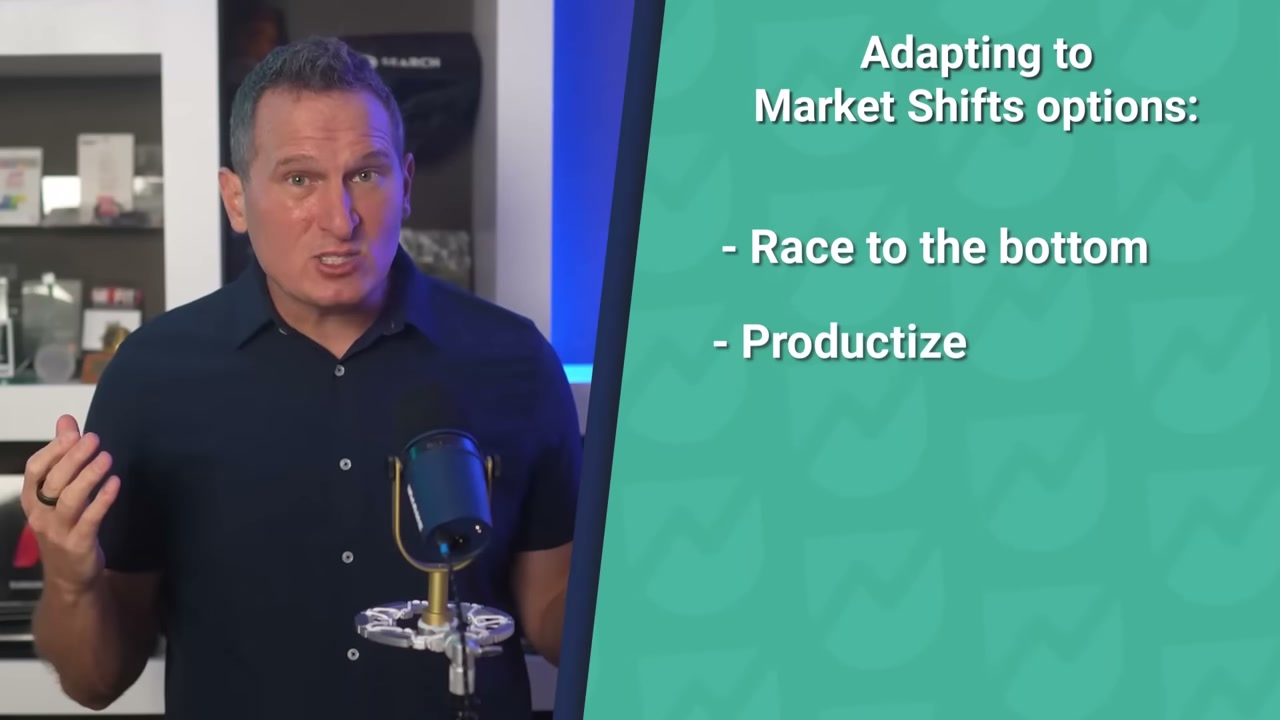
Option 1: Race to the Bottom
Cut your prices. Compete on volume. Accept that you're now a commodity and try to be the cheapest commodity.
Some people make this work. Mostly by burning out their team and eventually themselves.
I don't recommend it.
You're not Walmart, and you don't have the capital to compete on price or the reach to find the thousands of customers you'll need to make it happen.
Option 2: Productize Your Services
Take your best service, package it, and sell it at a fixed price with a clear scope.
This works better. Especially if you can systematize delivery and remove yourself from the day-to-day.
But it's still execution. Equally vulnerable to the same AI forces that are crushing everything else.
Option 3: Move Up the Stack
Stop selling execution. Start selling thinking.
Strategy. Advisory. Consulting on the thing instead of doing the thing.
This is where the margins are. But it requires a different skill set and a different kind of trust.
Though fair warning—AI is coming for strategy too. Just slower.
Option 4: Specialize So Narrowly That AI Can't Touch You
Become the person who knows one specific industry, platform, or problem better than anyone.
Not “we do marketing for e-commerce.”
More like “we do TikTok Shop launches for supplements brands doing $2-5M who've never sold on TikTok.”
That level of specific.
That's where the new agency model actually works. When you're the only person in the room who truly understands that particular problem, price compression disappears.
The 12-Person Agency Case Study
I talked to an agency owner last month who has restructured his entire team over the past 18 months.
He went from 35 people to 12.
Not because business was bad—because he realized 12 AI-enabled people could do what 35 traditional people were doing.
Same output. Fraction of the overhead.
He said something that stuck with me:
> “I'm not running an agency anymore. I'm running a concierge service for clients with a bionic workforce fueled by AI.”

That's not a joke. That's the new competitive landscape.
The agencies that are thriving right now? They've embraced AI marketing tools not as a threat but as a multiplier. They're doing more with less—and they're repositioning the value they provide from “we do the work” to “we make sure the work actually drives results.”
Which, by the way, is exactly where marketing ROI measurement becomes critical. When AI makes execution cheap, proving what actually works becomes the premium service.
What AI Still Can't Replace (And Why That's Your Moat)
So where does that leave you?
Honestly? In a better spot than you might think.
Because here's what AI still can't do:

- It can't sit in a room and read the politics between a CMO and a CEO. Those unspoken tensions that determine whether a campaign lives or dies? That requires human intuition.
- It can't tell when a client says “we love it” but means “we hate it but don't want to hurt your feelings.” Reading between the lines is still a human superpower.
- It can't build relationships with media buyers at platforms who'll give you alpha access to new features. Those connections take years to develop.
- It can't be the person the client calls when everything's on fire and they just need someone who gets it. Crisis management requires trust. And trust requires being human.
The boutique agencies winning right now? They're focused on precision. Deep expertise. Authentic, human-driven work that AI genuinely can't fake.
Yet.
I mean, give it 18 months. But for now, you've got a window.
The 18-Month Window
Here's what I need you to understand.
The window to reposition is not years. It's months.
The AI tools that exist today will be obsolete in 18 months. The strategies that work this quarter might not work next quarter.

Remember when everyone was saying “learn Clubhouse, it's the future”? That was like 3 years ago.
Now Clubhouse is basically a haunted house where you can hear your own echo.
That's how fast this moves.
And the agencies that survive—actually, scratch that—the agencies that THRIVE through this transition are the ones repositioning now. Not thinking about it. Doing it.
The Hard Math
I looked back at what happened to agencies that didn't adapt during the last major shift—the move to digital.
The ones that kept selling print ads and traditional media buying because “clients still want it.”
The vast majority of them either closed or got absorbed into bigger shops within 5 years.
Not because they were bad at their jobs. Because they were solving yesterday's problem.
The ones that are still in business? They solved specific problems and made themselves the anti-commodity.
And in 3 years, the holdouts from THIS shift? They'll be on LinkedIn posting about their “exciting new chapter.”
Which is code for “I got wrecked and I'm pretending it was my choice.”
Sorry. That was mean. But also kind of true.
The Bottom Line
The agency model isn't dying because agencies are bad.
It's dying because the OLD agency model—the one built on execution and deliverables and billable hours—is becoming worthless.
The new model is about access. Expertise. Judgment. Speed.
Things that can't be prompted.
I made my choice about 18 months ago. Started repositioning before I fully understood why. Looking back, that instinct probably saved the business.
The people who waited? Most aren't in the industry anymore. Some are doing great at other things. Some are very bitter on Reddit. You know the type. “Actually, AI is just a fad” posts with 47 upvotes from other people in denial.
Not that I check. Okay, I check sometimes. It makes me feel better about my choices.
Your Next Steps
1. Audit your current services. Which ones could a client's nephew do with ChatGPT and Canva? Those are your vulnerable offerings.
2. Pick your repositioning path. Race to bottom, productize, move up the stack, or hyper-specialize. Choose one.
3. Start the shift this quarter. Not next quarter. This one.
4. Focus on what's still human. Relationships, judgment, reading the room, crisis management. Double down there.
The question isn't whether this shift is real. It is real, and it will only get “realer” in the next 18 months.
The question is whether you're going to ride the wave or get crushed by it.
Ready to see the specific services that are actually in demand for agencies heading into 2026? I put together a list of 99 services—not the stuff that's already commoditized, but the stuff clients are starting to ask for right now.
I'd love to hear—are you already seeing this shift in your business? Or does it still feel like a future problem? Drop a comment on the YouTube video and let me know where you stand.