One point two humans. Twenty AI agents. Zero revenue loss.
That’s what it took to replace a 10-person sales team—documented in late 2025, not some projection or pilot program.
When I first saw that data, I thought it was cherry-picked nonsense. Some LinkedIn guru flexing made-up numbers. So I started digging through census data, actual agency P&L statements, and interviews with solo operators about their real numbers. Over 2,000 pages of research on what’s happening to agencies, freelancers, and consultants right now.
And here’s what I kept seeing: a single person with $500 a month in AI tools can now produce the same work that used to require a 10-person team costing $800,000 to $1.2 million per year in salaries alone.
The solo operator? They’re keeping 85 to 95 percent as pure profit. The traditional agency? Lucky to keep 6 to 15 percent.
We haven’t seen economics shift this dramatically since—honestly, maybe 100 years ago.
Watch the Full Breakdown
In this video, I break down the real math behind why solo operators with AI tools are outearning traditional agencies—and what you can do about it right now.
What You’ll Learn in This Post
- The profit margin gap between solo operators (85-95%) and traditional agencies (6-15%) has never been wider
- 29.8 million solopreneurs now generate $1.7 trillion in U.S. revenue—6.8% of GDP
- 74% of solopreneurs report scaling without hiring specifically because of AI tools
- The $500/month AI stack that replaces $200K+ in annual salaries
- Agentic AI will shift from tools to autonomous workflows by late 2026
- The window of advantage is open now but won’t stay open forever (24-36 months)
Table of Contents
- The Economic Flip: Why Traditional Agency Math No Longer Works
- The Real P&L: $600K Revenue, Two Completely Different Lives
- The Solo Operators Already Winning (Names You Can Google)
- The $500 AI Stack That Replaces a $200K Team
- Agentic AI: The 2026 Shift From Tools to Autonomous Workflows
- Service Stacking: The Three-Part System for Sustainable Solo Revenue
- The Four Limitations Nobody Talks About
- The Workforce Inversion: Why This Window Won’t Stay Open
The Economic Flip: Why Traditional Agency Math No Longer Works
If you run a small agency right now, you’re probably already feeling something’s off.
Your junior staff suddenly seem… replaceable. Clients are pushing back harder on your fees. You’re losing deals to people who work alone.
And if you’re thinking about going solo yourself—ditching the overhead, keeping more of what you earn—you’re probably wondering if that’s actually realistic. Or if everyone talking about it online is just selling courses.
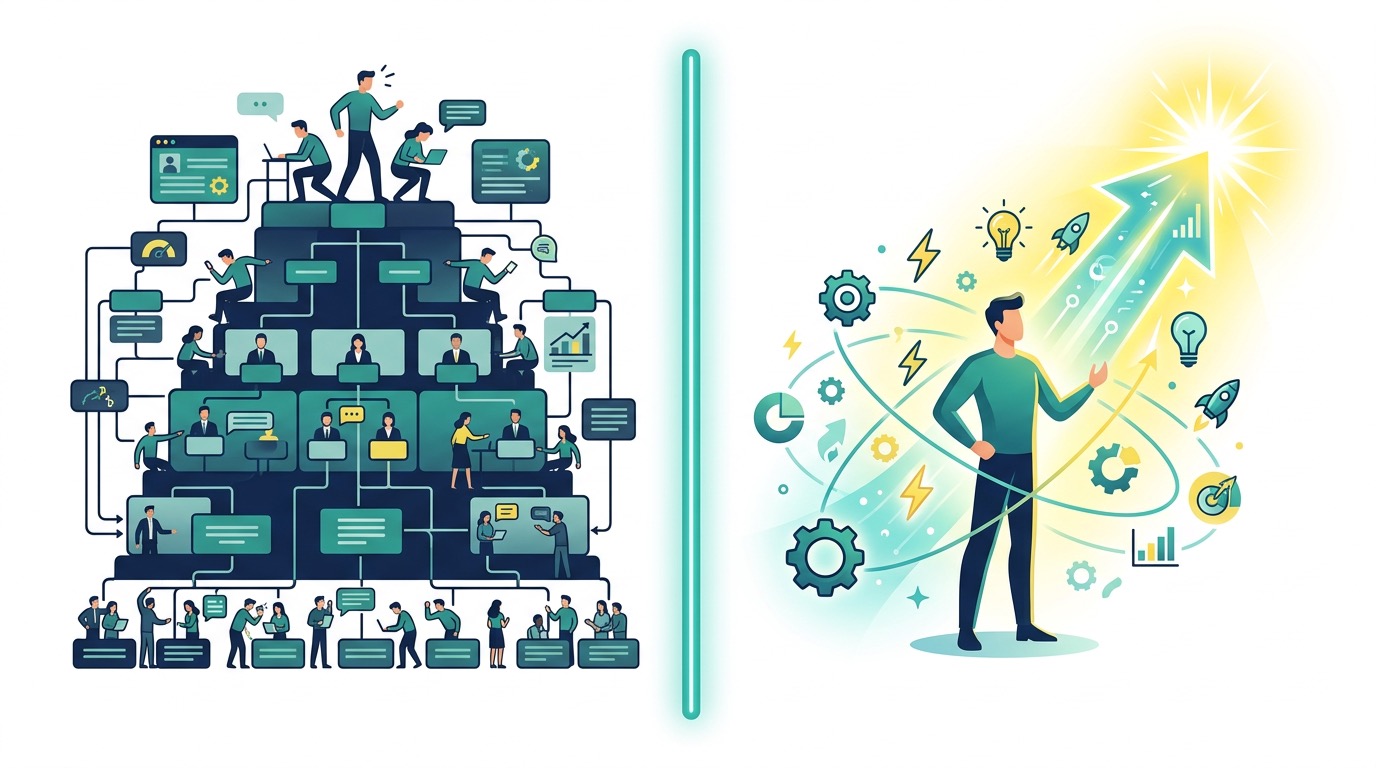
Let me give you some context. I’m Jeff Sauer. My partners and I built an agency the traditional way. Fifty-person team. Office. Overhead. All of it. Made the Inc 5000 five times. Sold that agency for eight figures.
And if I were starting over today? I’m not sure I’d hire anyone.
That’s not bitterness talking. I loved building that company. Great team, great clients, great run. But the math has changed.
The Real P&L: $600K Revenue, Two Completely Different Lives
Let’s do actual math—not vibe arithmetic or whatever the bros are calling it these days.
Traditional Agency Scenario:
Ten clients paying $5,000 a month each. That’s $600,000 a year in revenue. Sounds pretty good, right?
Here’s where it gets uncomfortable.
To service those ten clients properly, you probably need about five people:
- Account manager
- Designer
- Developer
- Project manager
- Junior help for day-to-day execution
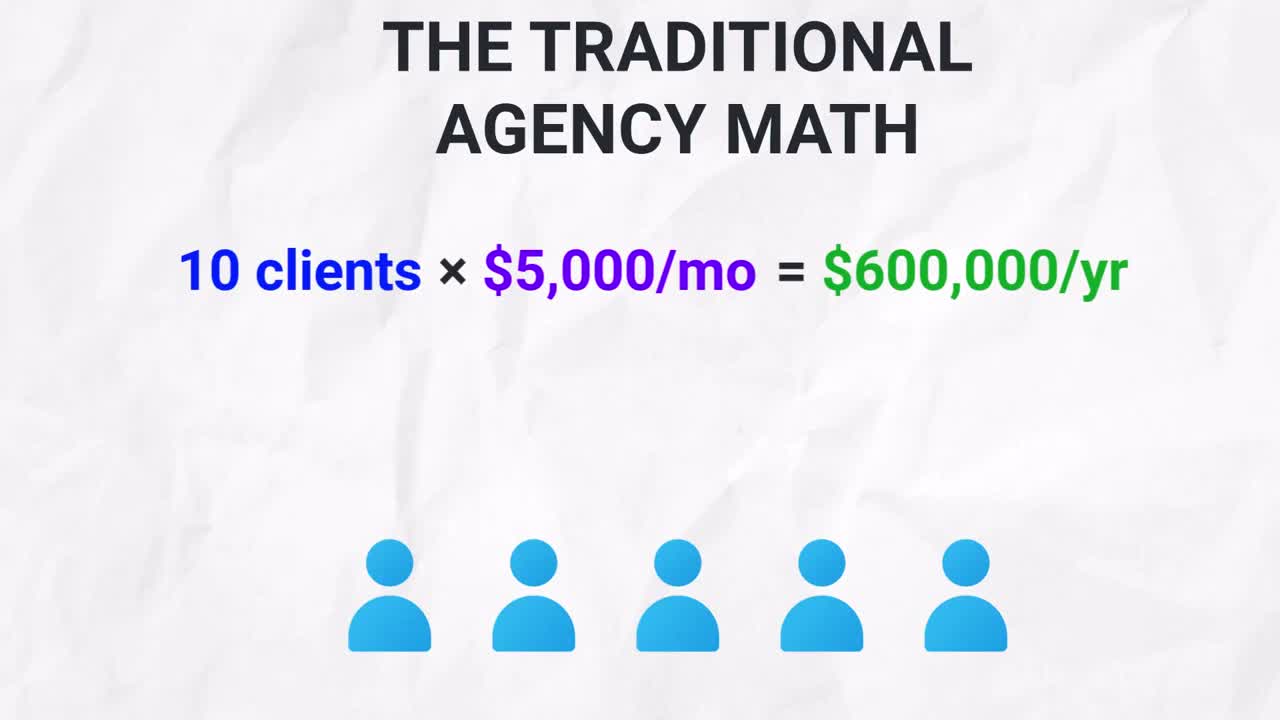
Average fully-loaded employee cost—salary plus benefits plus payroll taxes—runs about $80,000 to $100,000 per person. Call it $90K average.
Five people times $90K? That’s $450,000 just in payroll.
But wait—you also need software, project management tools, insurance, legal, accounting. Maybe some office space. Add another $75K to $100K in overhead.
So now you’re looking at roughly $525,000 to $550,000 in annual costs against $600,000 in revenue.
You’re profitable. Technically. You’re taking home maybe $50K to $75K. On $600,000 in revenue.
That’s a 10 to 12 percent margin—which is actually pretty normal for agencies.
But here’s the thing: you lose one client? You’re underwater. Someone gets sick for a month? Margins gone. A project goes sideways and you eat the overage? Now you’re working for free.
Solo Operator Scenario (Same Revenue):
Same ten clients. Same $5,000 a month each. Same $600,000 in revenue.
What are your costs?
- AI subscriptions (ChatGPT Pro, Claude, Midjourney, specialty tools): $300-500/month = $6,000/year
- Contractors for overflow work: $2,000-3,000/month = $30,000/year
- Software (CRM, invoicing, project management): $200-300/month = $3,000/year
- Home office, internet, coworking sometimes: $10,000/year misc
Total costs: roughly $50,000 to $75,000
Against $600,000 in revenue.
You’re clearing somewhere between $525,000 and $550,000 in profit. That’s an 85 to 90 percent margin.
Same clients. Same revenue. Completely different life.
And here’s the part that breaks people’s brains: the solo operator isn’t working harder. In many cases, they’re working less. Because they’re not managing five people. They’re not sitting in status meetings. They’re not dealing with HR issues or trying to keep junior staff productive.
They’re just doing the work. With AI handling the parts that used to require a team.
The Solo Operators Already Winning (Names You Can Google)
So those numbers look good on paper. But who’s actually doing this?
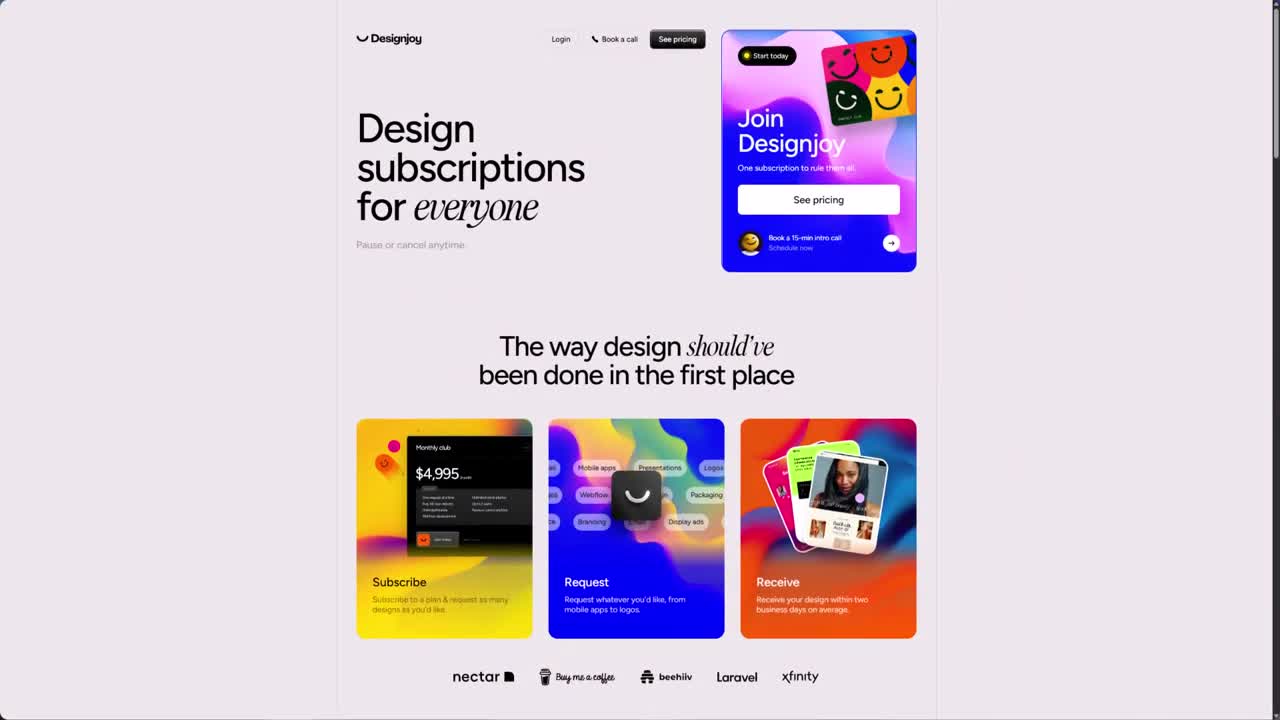
Brett Williams runs DesignJoy. It’s a productized design subscription—clients pay $5,000 a month for unlimited design requests. He runs it completely solo. No employees. No meetings. Just him and a Trello board.
Revenue? Somewhere between $1.3 and $2 million a year. By himself.
Justin Welsh builds content systems and digital products. Courses, newsletters, consulting. $4 to $5 million a year. Zero full-time employees.
Dan Koe—similar story. Multi-million dollar creator business. Tiny team, mostly solo operation.
And before you say “these are famous internet people with audiences”—okay, fair. Here are some less famous examples:
- $25,000/month running paid ads for local businesses
- $40,000/month doing fractional CMO work
- $75,000/month with a productized SEO service
- $450,000/month doing email marketing at scale
That last one kind of blew my mind. Traditional email marketers create maybe 10 to 15 variations per campaign. This operator was using AI to generate 80 to 150 variations per campaign. Testing at a scale that would have required a team of eight to do manually.
One person. AI tools. $5.4 million a year.
The Census Data:
The U.S. Census Bureau tracks self-employment data. There are now 29.8 million solopreneurs in the United States. Together, they generate $1.7 trillion in revenue. That’s 6.8 percent of U.S. GDP.
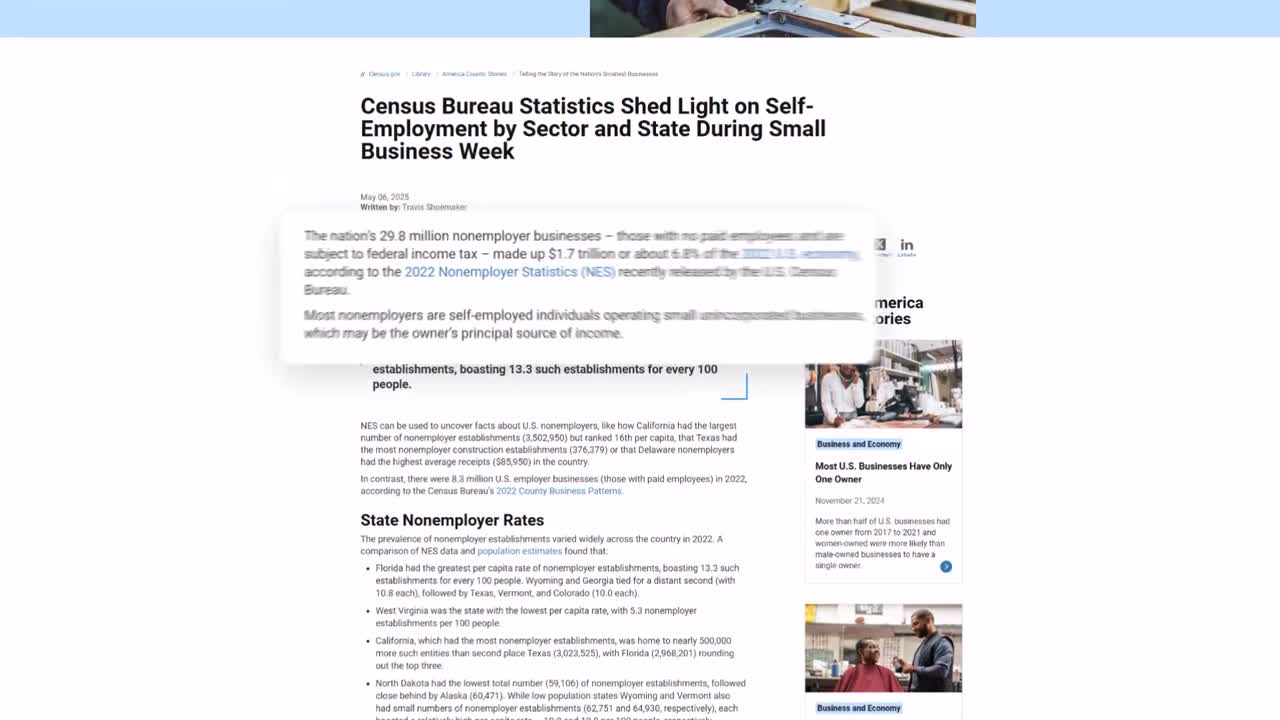
Not small businesses with employees. Solopreneurs. One-person operations.
And here’s the stat that stopped me cold: Zoom and Upwork commissioned research on how these solopreneurs are scaling. 74 percent of them said they’ve been able to grow their business without hiring anyone—specifically because of AI tools.
That’s not early adopters or tech-savvy outliers anymore. That’s three-quarters of solo operators saying AI changed their capacity equation.
The $500 AI Stack That Replaces a $200K Team
When I say “$500 a month in AI tools for marketers”—that’s not one subscription. That’s an entire team’s worth of capability spread across a handful of platforms.
Here’s what a typical stack looks like:
For thinking and writing:
- ChatGPT Pro or Claude Pro (~$100/month each)
- These are your strategists, first-draft writers, research assistants

For visual work:
- Midjourney, DALL-E, Adobe Firefly, or Gemini with Imagen ($20-60/month)
For video:
- Descript, Runway, or CapCut Pro ($20-50/month)
- Editing capabilities that used to require a dedicated person
For voice and audio:
- ElevenLabs, Descript, Whisper ($20-30/month)
- Transcription, voiceovers, audio cleanup
For automation and workflows:
For meetings and calls:
- Fireflies, Otter, or Fathom ($20-30/month)
- Record, transcribe, and summarize every client conversation automatically
For project management and CRM:
- Notion, ClickUp, HubSpot free tier ($0-20/month)
Total: $400 to $600 a month. Call it $7,000 a year on the high end.
Now think about what that replaces:
- Junior designer: $50,000-60,000/year
- Video editor: $45,000-55,000/year
- Admin/project coordinator: $40,000-50,000/year
- Copywriter: $50,000-70,000/year
That’s $185,000 to $235,000 in salaries for four entry-level hires. Or $7,000 in software.
I’m not saying AI does these jobs perfectly. It doesn’t. But it does them well enough that an experienced operator can fill in the gaps themselves.
And that’s the key part. You’re not replacing skilled humans with AI. You’re replacing the need for a team by combining AI capability with your own expertise. The AI handles the production. You handle the thinking.
Agentic AI: The 2026 Shift From Tools to Autonomous Workflows
Everything I just described? That’s the current state of AI tools. Stuff you can use right now, today.
But there’s a shift coming in 2026 that most people aren’t paying attention to. It’s called agentic AI. And it’s going to make the current tools look like calculators compared to spreadsheets.
The simplest way I can explain it:
Right now, most people use AI like a tool. You open ChatGPT. You type a prompt. You get an output. You copy and paste it somewhere. That’s useful. But it’s manual. You’re still the one doing the work.

Agentic AI is different. Instead of you prompting a tool over and over, you give an AI agent a goal—and it figures out how to complete it. It breaks down the task. It decides what steps to take. It uses other tools along the way. It checks its own work. And it delivers a finished result.
You’re not managing prompts anymore. You’re managing outcomes.
The market data:
The agentic AI market was valued at $7.8 billion in 2024. By 2030, projections put it at $52.6 billion. That’s a 46.3 percent compound annual growth rate.
When markets grow that fast, it’s because the technology is solving real problems for real businesses.
Concrete example—traditional workflow for a client report:
- Pull data from three different platforms: 15 minutes
- Paste it into a spreadsheet and clean it up: 20 minutes
- Analyze the trends and write up insights: 20 minutes
- Format it into a presentation: 10 minutes
Total: about 65 minutes of your time. For one client. One report. One week.
Agentic AI agent workflow:
You tell the agent: “Pull this week’s performance data for Client X. Analyze it against last month. Flag anything unusual. Generate a summary with recommendations. Format it as a PDF report.”
The agent does all of that. You review the output. Make a few tweaks.
Total time: maybe 10 minutes. Same deliverable. 85% less time.
Platforms like Salesforce Agentforce, HubSpot Breeze, CrewAI, LangChain—they’re building this infrastructure right now. By late 2026, early 2027, this is going to be standard.
That’s where the AI agency model gets even more interesting. The freelancers and small agencies who figure out AI agent workflows first? They’re going to have a massive advantage. Because they won’t just be replacing a team’s worth of production. They’ll be running systems that work while they sleep.
Service Stacking: The Three-Part System for Sustainable Solo Revenue
So if you’re a freelancer or small agency owner thinking “okay, the math makes sense, but what do I actually sell?”—this is the part you’ve been waiting for.
I call it Service Stacking. And it’s not what most people think when they hear “stack your services.” It’s not about bundling everything together into one giant retainer and hoping the client says yes. That’s actually a terrible way to sell.

Service Stacking is a three-part system:
Part One: The Low-Risk Offer
This is how you get your foot in the door. Something small, fast, and valuable. An audit. A strategy session. A roadmap. Something that costs them $1,500 to $3,000 and takes you a day or two to deliver.
The whole point is to reduce their risk of working with you. They don’t know you yet. They’re not ready to commit $10K a month. But they’ll pay a little to see what you’ve got.
And here’s the key—the low-risk offer isn’t just standalone. It’s designed to sell the next offer.
Part Two: The Implementation Offer
This is where you actually do the work. You’ve just told them “here are the seven things broken in your funnel” or “here’s the content strategy you’re missing.”
At that point, it’s risky NOT to implement. They’ve seen the problem. They trust your diagnosis. Now you’re the obvious person to fix it.
Implementation offers are usually 2 to 4 times the cost of your audit. So if your audit is $2,000, implementation runs $4,000 to $8,000.
Part Three: The Retainer
This is recurring revenue. Once you’ve implemented something, it needs to keep working. Ads need optimization. Content needs to keep publishing. Systems need maintenance and improvement.
Typical retainers run about one-fourth to one-sixth of your implementation cost. So if implementation was $6,000, you’re looking at $1,000 to $1,500 a month.
Each part sells the next.
Three Examples in Practice:
The Growth Stack:
- Low-risk: Paid ads audit for $2,000
- Implementation: Build and launch new campaign structure, $5,000-8,000
- Retainer: Ongoing ads management plus landing page optimization, $1,000-2,000/month
The Brand Stack:
- Low-risk: Messaging workshop for $2,500
- Implementation: Build out content system—templates, workflows, first 90 days of content, $6,000-10,000
- Retainer: Content management and publishing, $1,500-2,500/month
The AI Transformation Stack:
- Low-risk: AI readiness assessment for $3,000
- Implementation: Build and deploy top 3-5 AI workflows, $8,000-12,000
- Retainer: Ongoing optimization, new workflow development, team training, $1,500-3,000/month
See how each part connects? The low-risk offer makes the implementation obvious. The implementation makes the retainer necessary. You’re not convincing anyone of anything. You’re just moving them through a logical sequence.
The Four Limitations Nobody Talks About
Everything I’ve said so far makes this sound like a no-brainer. And it’s not. There are real limitations to this model. If I don’t tell you about them, I’m doing you a disservice.
Limitation 1: The Revenue Ceiling
Most freelancers and small agencies running this model cap out somewhere between $300,000 and $500,000 a year. Some push past that—we talked about the outliers doing $1 million, $5 million. But those are outliers.
For most people, there’s a natural ceiling based on how many clients you can serve and how much you can charge. That’s okay—$300K at 85% margins is a great living. But if your goal is to build a $10 million company, this isn’t the path.
Limitation 2: Burnout Is Real
When you’re the strategist, the project manager, the client relationship person, and the one doing the work—that’s a lot of hats.
AI helps with production. It doesn’t help with decision fatigue. If you’re not careful, you end up working 50-hour weeks wondering why you left your job in the first place.
The fix is boundaries and systems. But you have to build those intentionally.
Limitation 3: The Enterprise Gap
Big companies—Fortune 500, large mid-market businesses—a lot of them still want to hire “real” agencies. They want the safety of a bigger team. They want someone to blame if things go wrong. They want the optics of working with a company that looks like theirs.
You can win some enterprise deals as a solo operator. But you’re fighting an uphill battle. This model works best with small and mid-sized businesses, startups, and founder-led companies. People who care more about results than org charts.

Limitation 4: Commoditization
Here’s the uncomfortable truth. Everything I just taught you? Other people are learning it too. AI tools are available to everyone. Service Stacking isn’t a secret anymore.
Which means the window of advantage is going to close at some point. Right now, freelancers and small agencies who understand this model have a real edge. In three years? It’ll be table stakes.
I don’t say all this to discourage you. I say it because I want you to go in with clear eyes. The math works. The model works. But it’s not magic. It’s a business.
Here’s how I think about it:
$100,000 to $300,000 a year. 85% or higher margins. 30 to 35 hours a week.
That’s what this model can reliably deliver for someone with 5 to 15 years of experience who’s good at what they do. And honestly? That’s a lifestyle most agency owners would kill for. They’re doing $500K in revenue, taking home $50K, and working 60-hour weeks.
You could do half the revenue, take home five times the profit, and work fewer hours. That’s the real comparison.
The Workforce Inversion: Why This Window Won’t Stay Open
So why is this window open right now? And why won’t it stay open forever?
It comes down to something I call the workforce inversion.
For the past fifty years, the career ladder looked the same. You start at the bottom. Entry-level. Junior roles. You do the grunt work. You learn by doing. You get promoted. You eventually move into strategy and management.
That ladder made sense because companies needed people to do the production work. Someone had to write the first draft. Someone had to resize the images. Someone had to pull the reports and format the spreadsheets. That’s what junior staff did.
And here’s what’s happening right now: AI is eating the bottom of the ladder.
Those entry-level production tasks? The stuff that used to take a junior person four hours to do? AI does it in four minutes.
Which means companies don’t need as many junior people. And that’s not speculation. The data is brutal.
Entry-level software engineering roles used to make up 43 percent of job postings. Now it’s 28 percent. That’s a 15-point drop in the share of entry-level positions.
In the UK, creative agency jobs for people under 25 dropped 19.2 percent in the last year. That’s the biggest decline since the 1950s.
We’re watching the entry-level job market collapse in real time.
But here’s the flip side—senior talent is more valuable than ever.
Because AI can’t do strategy. AI can’t build client relationships. AI can’t sit in a room and figure out what a business actually needs. That requires judgment. Experience. The stuff you only get from doing this for 5, 10, 15 years.
So the ladder is inverting. The bottom is shrinking. The top is expanding.
And if you’re someone with experience—real, hard-won expertise—you’re in the best position you’ve ever been in. Because you can now do the work of an entire junior team using AI as your production layer. You don’t need to hire to scale your output anymore.
That’s the inversion. Junior roles are disappearing. Senior operators are thriving.
Right now, most people haven’t figured this out yet. Most freelancers and small agencies are still operating the old way. Still trying to hire junior staff. Still building teams they don’t need. Still competing on headcount instead of outcomes.

If you move now—if you build this model while everyone else is still catching up—you get a head start that compounds over time. Better clients. Higher rates. Stronger reputation.
But if you wait? If you sit on this for two or three years? You’ll be building the same model as everyone else, at the same time, with no advantage.
That’s the window. And it’s not going to stay open forever.
Your Next Steps
So let’s bring this back to where we started.
One point two humans. Twenty AI agents. Zero revenue loss. That’s not a fantasy. That’s a documented case study.
And the math we walked through? Not theory either.
- Traditional agency: $600K revenue, $50K-75K profit, one bad month away from underwater
- Freelancer with AI leverage: Same $600K revenue, $525K-550K profit, working fewer hours with no team to manage
Same clients. Same deliverables. Completely different life.
Here’s what I believe: $100K to $300K a year. 85% margins. 30 to 35 hours a week. No employees. No office. No overhead.
For someone with 5 to 15 years of experience, that’s not just possible right now. It’s almost inevitable—if you set it up correctly.
Ready to build your own stack?
Check out the full list of 99 freelance marketing services to find the right low-risk offer, implementation service, and retainer for your specific skills and market.
The economics of services have changed. The tools have changed. The opportunity is here.
The only question is whether you’re going to move on it.