Tired of explaining to clients why their ad platform says 11 conversions when you know the campaign drove way more than that?
You're not imagining things. And it's not a bug. That's the new normal—unless you fix the infrastructure.
I've been in digital marketing for over two decades, and I've watched this exact pattern play out before. A technical shift happens, most people ignore it because it seems too complicated or too early, and a small group moves fast and locks in premium positioning before everyone else catches up.
That's where server-side tracking comes in.
Watch the Full Breakdown
Key Takeaways
- Server-side tracking adoption is projected to jump from 5-20% to 70% by 2027—that's 300-400% market growth in roughly 24 months
- Traditional browser-based tracking is actively being killed by ad blockers, privacy regulations, and platform changes (85% of iOS users opted out of tracking)
- This skill set creates a 3-tier service stack: implementation projects ($2K-$15K), monthly retainers ($1.5K-$5K), and strategic advisory ($50K+ engagements)
- The agencies who figure this out now will own the space before most people realize there's a space to own
Table of Contents
- The Window Is Open (Again)
- Why Traditional Tracking Is Dying
- How Server-Side Tracking Actually Works
- The Market Opportunity Nobody's Talking About
- The Server-Side Service Stack: Three Ways to Monetize
- What This Means for Your Agency
The Window Is Open (Again)
Every few years, a window opens for marketing agencies and freelancers. A new platform. A regulation change. A technical shift that most people ignore.
For me it was Google AdWords in 2006. I was working at an agency and we figured out this paid search thing while everyone else was still blowing budgets on billboards. Companies were paying $700 per lead for offline marketing. We got them the same leads for $35.
For others it was Google Tag Manager—remember when half the industry said “why would I need to collect that data?” Now try measuring marketing results without it.
A few years ago we saw it with the GA4 migration. Absolute chaos for most agencies. But the ones who got ahead of it? They became the experts everyone else hired.

What about GDPR and the privacy apocalypse led by iOS 14.5? Some agencies lost 60% of their clients' conversion visibility overnight. Others had already built the workarounds and doubled their retainers.
The pattern is always the same:
- A new technology emerges that's poised to disrupt marketing
- A small group moves early and figures it out
- They lock in premium positioning before the market catches up
- Everyone else is too busy milking their cash cows to notice—or too scared to learn something new
Right now, we're in another one of those windows. And this one might be bigger than all of them.
Why Traditional Tracking Is Dying
The way we've been tracking marketing for the last 15 years is dying. Not slowly dying. Actively being killed.
Here's what's happening:
- Browsers are blocking third-party cookies. Safari and Firefox already did it. Chrome keeps pushing back the deadline but it's coming.
- Apple gave users a one-tap opt-out of tracking. 85% of them said “yeah, no thanks.”
- Privacy regulations are multiplying. GDPR was just the appetizer. Now we've got state-level laws popping up across the US like whack-a-mole.
And here's what that means for agencies and consultants:
Your clients' data is getting worse. Their attribution is getting fuzzier. Their ad platforms are guessing more and knowing less.
If you're running Facebook ads or Google ads for clients right now, you've probably noticed the numbers don't add up like they used to. Conversions that used to be tracked are just… gone.

You know the marketing is working. The client's revenue is up. But the platform says you drove 11 conversions last month and everyone's looking at each other like… that can't be right.
Most businesses have no idea this problem exists. They just know their numbers look weird and their ad performance seems off.
So they blame the agency. They start wondering if you're actually doing your job. They're half-drafting that email about “exploring other options” before you even know something's wrong.
How Server-Side Tracking Actually Works
Traditional tracking—the kind most websites still use—works like this:
- A visitor lands on your site
- A little piece of JavaScript fires in their browser
- That script sends data to Google or Facebook or wherever
The problem? That all happens in the browser. And browsers are now actively blocking that stuff. Ad blockers kill it. Privacy settings kill it. Safari kills it just for fun.
Server-side tracking flips the whole thing.

Instead of the browser sending data directly to these platforms, your server sends it. Your infrastructure. Something you control.
The visitor's browser talks to your server. Your server talks to Google, Facebook, your analytics, whatever you need.
Why does that matter?
- Ad blockers can't block your own server. It's your domain, your infrastructure.
- Privacy restrictions on browsers don't apply the same way. You're not relying on third-party cookies that are getting nuked from orbit.
- You own the data pipeline. That means first-party data. Consent-compliant data. Data that actually holds up when a client asks “prove this campaign worked.”
And here's the part most people miss—this isn't just about getting your tracking to work again. It's about getting BETTER data than you ever had before.
That's the game now.

The Market Opportunity Nobody's Talking About
Right now, somewhere around 5 to 20 percent of small and medium sized businesses have adopted server-side tracking. Depending on whose research you trust.
By the end of 2027, that number is projected to hit 70 percent.
That's not my opinion. That's data from Usercentrics.
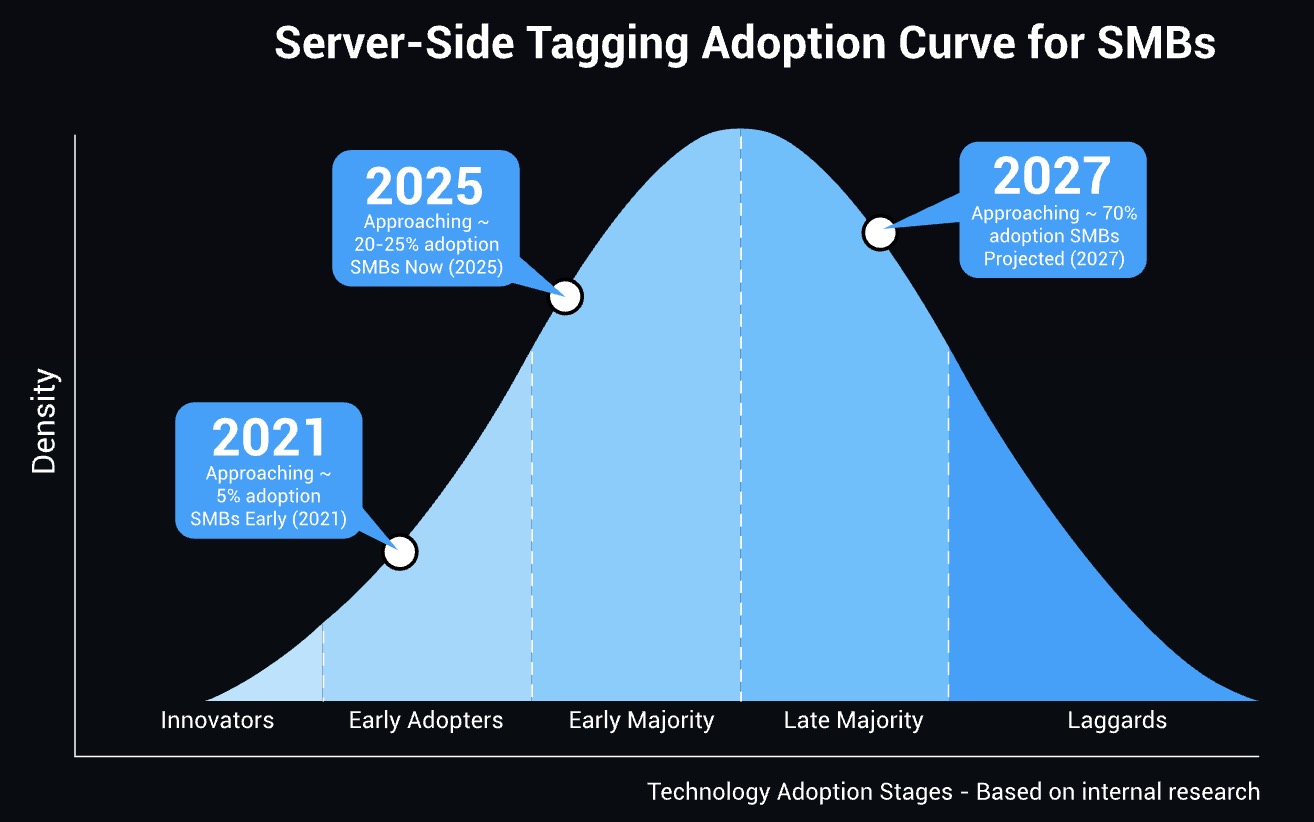
We're talking about 300 to 400 percent market growth in roughly 24 months.

The agencies and consultants who figure this out now? They're going to own this space before most people even realize there's a space to own.
They're not going to fix this themselves. They don't have the technical chops. They don't even know what questions to ask.
That's your opening.
Right now, the people who can actually implement server-side tracking are rare. And the ones who can explain it to a business owner without sounding like my old computer science professor? Even rarer.
Supply and demand.
When Google Tag Manager came out, the people who learned it early could charge whatever they wanted because nobody else knew how to do it. I watched consultants go from billing $75 an hour to $300 practically overnight.
Same thing happened with GA4. The people who got certified early and could actually migrate clients without breaking everything? They had six-month waitlists.
Server-side is the same pattern. Except the market is potentially bigger and the stakes are higher.
We're not talking about “nice to have” analytics anymore. We're talking about whether a business can track their marketing at all.
That's not a hard sell. That's a “holy crap, fix this now” conversation.
And if you're the one who can fix it? You name your price.
The Server-Side Service Stack: Three Ways to Monetize
So let's talk about how this actually turns into money.
Because “learn server-side tracking” is not a business model. It's a skill. The business model is what you do with it.
I wrote a book called Service Stacking about how agencies and consultants structure their offers. And server-side fits the framework perfectly.
You've got three levels:

Level 1: The Foot-in-Door Service (Implementation)
A client comes to you, their tracking is broken, you fix it. One-time project.
Pricing range: $2,000 to $15,000 depending on complexity
This is how you get in. Low commitment for them, high value, and now you're the person who understands their data infrastructure better than anyone.
Level 2: The Retainer Service (Management)
Here's what most people don't realize—this stuff needs maintenance.
- Platforms change their APIs
- Privacy regulations update
- Consent tools break
- Data pipelines need monitoring
Someone has to keep the lights on. That someone should be you.
Pricing range: $1,500 to $5,000 per month
Now you're not a vendor. You're embedded.
Level 3: The Full-Service Offer (First-Party Data Strategy)
This is where you zoom out and help them see the bigger picture. It's not just “fix tracking” anymore. It's “let's build a data asset that makes your marketing smarter over time.”
- Customer data platforms
- Consent architecture
- Attribution modeling that doesn't fall apart when cookies disappear
Pricing range: $50,000+ engagements
This is the ongoing advisory relationship. The stuff that makes you un-fireable.
One skill set. Three offers. A whole revenue ladder.

What This Means for Your Agency
Look, server-side tracking isn't for everyone. Maybe you watched this thinking “interesting, but not for me.”
That's fine.
But if you're the type of agency or consultant who's been watching these windows open and close—AdWords, GTM, GA4, iOS privacy—and you're tired of being the one who catches up instead of the one who gets ahead?
This is your shot.
The window's open. What you do next is up to you.
Ready to Get Started?
Here's what I'd recommend:
1. Start having conversations with clients about their tracking infrastructure before they blame you for numbers that don't add up
2. Learn the technical fundamentals—we've got a full course at serversideblueprint.com that walks you through implementation step by step
3. Build your service stack using the three-tier framework above
Get the 99 Services List
Server-side is just one of them. But right now? It's the one where the timing is perfect and the market is about to explode.
Good luck with your server-side journey—I’d love to hear how it goes. Drop a comment on the video and let me know where you're at with server-side tracking.