“By 2028, we'll double profits and halve the people.”
That's not some anonymous Reddit comment. That's a global holding company CEO talking to Forrester, as reported by The Drum. On the record. About what's coming for hundreds of thousands of agency employees.
Fifteen percent of agency jobs eliminated this year. Not over the next decade—this year. Forty-seven thousand positions gone in twelve months. And the rise of AI automation agencies that can deliver comparable results with 80% less overhead is accelerating faster than anyone predicted.
I'm going to show you who's on the kill list.
Why I'm Writing This (And Why You Should Care)
I'm Jeff Sauer. Along with my partners, I built an agency, grew it 1,000% in five years, made the Inc 5000 list five times, and sold it for eight figures.
So when Forrester says 15% of agency jobs vanish, I don't need to guess what that looks like. I watched it happen during the digital disruption from 2008 to 2012. I've spent months compiling over 2,000 pages of research on what's coming this time.
And I can tell you—this is worse. It's faster. And most people in the industry have no idea which side of this they're standing on.
Watch the Full Breakdown
What You'll Learn
- Forrester doubled their job loss prediction and compressed 8 years into 1
- 82% of brands now have in-house agencies (up from 58% in 2013)
- AI-enabled micro-agencies operate at 50-80% margins vs. traditional 15-20%
- The entry-level path into agencies is disappearing entirely
Table of Contents
- The Forrester Prediction: What Changed
- Agency CEOs Say the Quiet Part Out Loud
- The Kill List: Which Roles Are Getting Cut
- Why the Traditional Agency Business Model Can't Adapt
- Who Survives: The New Winners in AI Automation Agencies
- How to Position Yourself on the Winning Side
- Frequently Asked Questions
The Forrester Prediction: What Changed
Let me tell you exactly what Forrester said, because the original prediction wasn't scary enough. Then they made it scarier.
Back in 2022, Forrester projected that 7.5% of US agency jobs would be automated by 2030. About 32,000 positions over eight years. That felt manageable. Gradual. Something the industry could absorb.
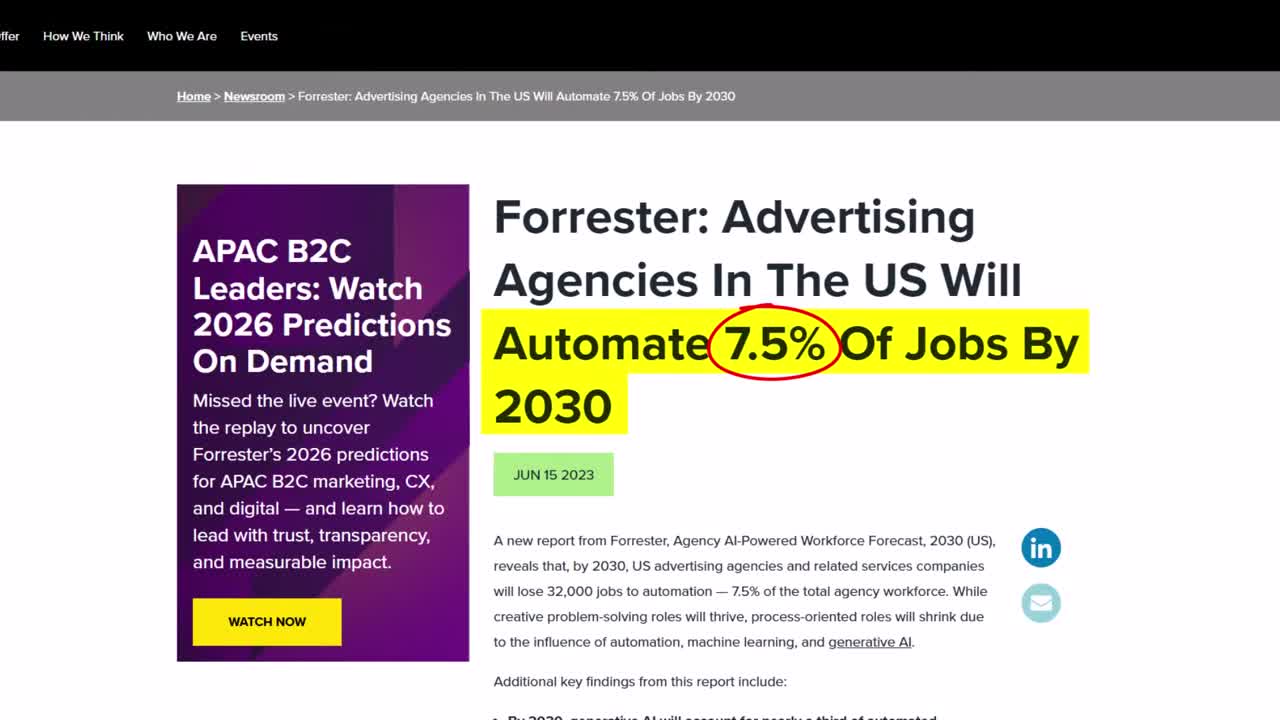
Then late 2025, they threw that out.
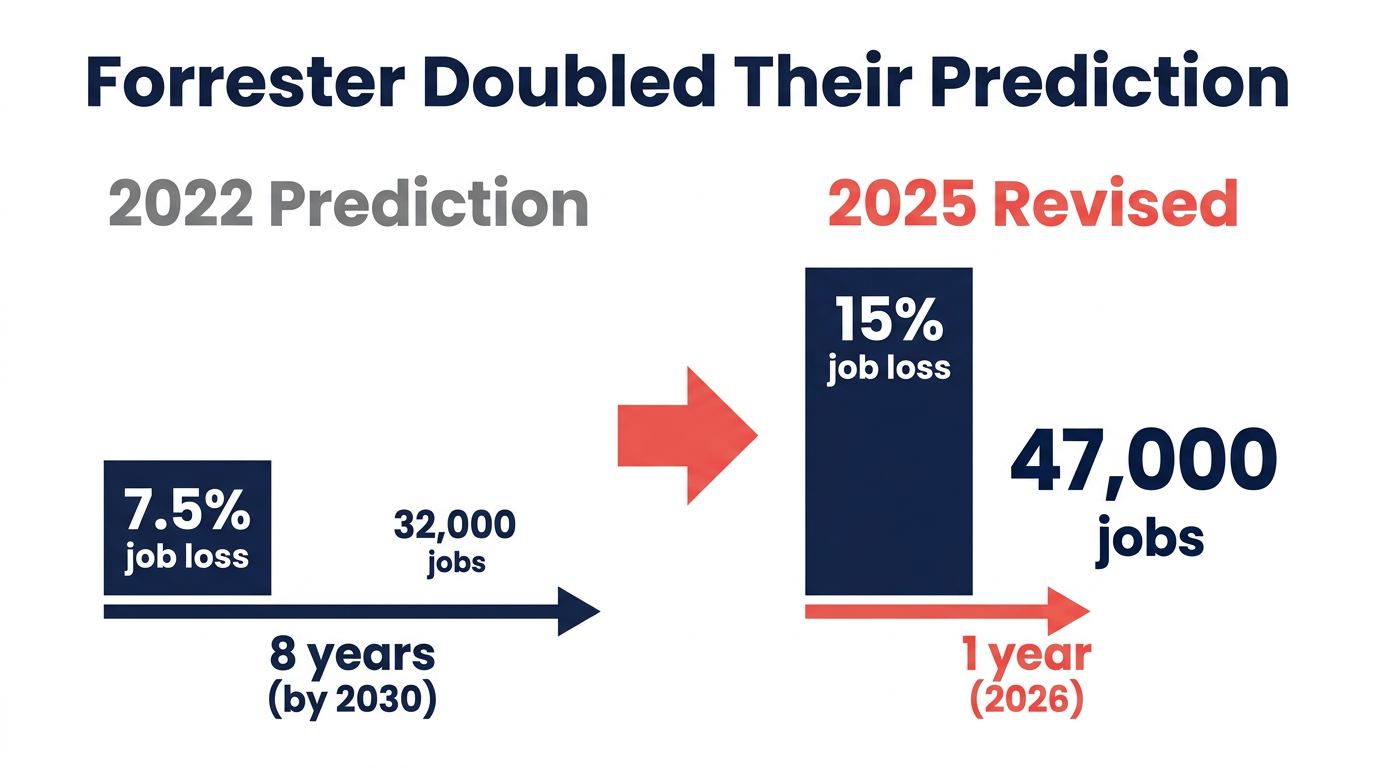
New prediction: 15% eliminated in 2026 alone.
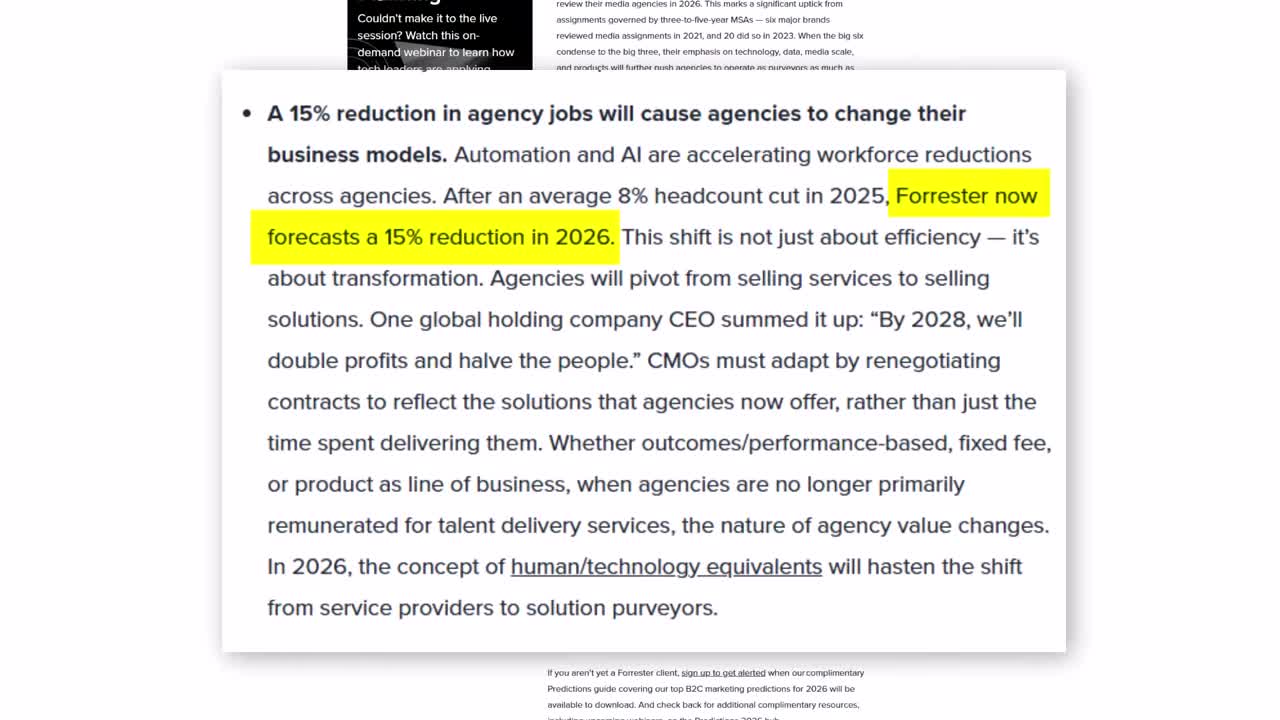
They didn't just move up the timeline. They doubled the severity and compressed eight years into one.
Jay Pattisall—he's the VP and Principal Analyst at Forrester—described what's happening as a complete transformation. His words: agencies are no longer acting as agents. They're becoming “marketing purveyors”—selling products, technology, and media rather than service hours.
What This Actually Means
That sounds abstract until you understand the mechanics. The traditional agency business model is built on one thing: selling time. You hire people, you bill their hours, you mark up the labor. That's how agencies have worked for a century.
AI breaks that model.
When AI can do in seconds what used to take a junior team a week, you don't need the junior team. And when you don't need the junior team, you don't need the middle managers supervising them. And when you don't need either, you start asking why you're paying for the office space they sat in.
The holding company CEO who said “double profits, halve people”? They're not being cruel. They're just doing the math.
Agency CEOs Say the Quiet Part Out Loud
Here's what's wild about this moment. Agency CEOs aren't hiding it anymore. They're saying it publicly.
Publicis: The Winner Is Still Cutting
Arthur Sadoun, CEO of Publicis—the best performing holding company right now—told investors that 80% of revenue from their media business now comes from AI-driven work. Eighty percent.
He said AI handles “everything from how clients plan and buy media to how campaigns are optimized and measured.”
His exact words: “The tech is doing the heavy lifting.”
Publicis grew revenue 5.6% last year while other holding companies declined. They beat their peers by about 700 basis points. And they did it without adding headcount.

In fact, they still cut around 200 people—even the winner is cutting.
WPP: 7,000 People Gone
Over at WPP, headcount dropped from 111,000 to 104,000 in about a year. Seven thousand people gone.
At the same time, 85% of their client-facing staff are now using their AI platform.
Notice the correlation: headcount down 7,000, AI usage at 85%.
The new WPP CEO called 2025 performance “unacceptable” and brought in McKinsey to advise on transformation. Revenue is expected to decline another 5-6% this year.
Omnicom-IPG: $750 Million in “Cost Savings”
Omnicom just merged with IPG and they're targeting $750 million in cost savings. The CFO was pretty clear about where that comes from: “Labor costs always lead the balance sheet.”
They went from 128,000 combined staff to about 105,000 in roughly one year.
And they just retired three iconic agency brands—DDB, FCB, and MullenLowe.
DDB was founded in 1949. FCB was founded in 1873. These brands survived world wars. They survived the Great Depression. They survived the dot-com crash and the 2008 financial crisis.
These brands didn't survive this.
The Kill List: Which Roles Are Getting Cut
So who's actually getting cut? Forrester broke it down.

The percentages:
- 28% of job losses are clerical and administrative—data entry, scheduling coordinators, expense reporting, admin assistants. The stuff AI handles almost trivially now.
- 22% are sales and business development roles—the junior people who researched prospects, drafted proposals, coordinated outreach. AI does that faster and doesn't need a salary.
- 18% are market research positions—survey analysis, data synthesis, report writing. An agency that needed ten researchers can now deliver comparable output with three using AI tools.
But those are just the percentages. Let me get specific about roles.
Junior Copywriters
AI generates thousands of headline variations in seconds. The apprenticeship model where you learned by writing low-level copy? That's broken. There's no on-ramp anymore.
Media Planners
Sir Martin Sorrell—who founded WPP and now runs S4 Capital—said something that should terrify anyone in media:
“There are 250,000 people in media planning and buying. There won't be 250,000 jobs in two to three years.”
His argument is that media buying becomes completely algorithmic—Performance Max, Advantage+, the platforms do the targeting, allocation, and bidding automatically.
Production Artists and Junior Designers
AI image generation lets you resize assets, remove backgrounds, create variations instantly. Tasks that required teams of juniors are now one-click operations.
Account Coordinators
Scheduling, routing, status tracking. AI handles all of it.
The Workforce Inversion
Forrester calls this the “workforce inversion.” Historically, agencies made money through labor arbitrage. You had expensive creative directors overseeing cheap junior talent. You had expensive account directors managing through junior coordinators. The juniors did the volume work, the seniors supervised, and the spread was profit.
AI inverts that completely. You don't need the junior layer anymore. The model flips to small teams of senior talent working directly with AI assistants.
Forrester's exact language: “The more creative and original the agency role, the less likely it will be replaced. Originality is the most significant factor that lowers a job's automation potential.”
The entry-level path into the industry is disappearing. And the mid-level roles that supervised entry-level work are disappearing with them.
Why the Traditional Agency Business Model Can't Adapt
Here's the part that doesn't get talked about enough. It's not just that big agencies are slow to adopt AI. It's that their entire agency business model makes adaptation almost impossible.
The Overhead Trap
Take a 1,000-person agency. You're carrying somewhere between $50 and $75 million in annual overhead. Real estate, management layers, HR, legal, finance, technology infrastructure. That's 15 to 25 percent of gross revenue before you've spent a dollar on actual project work or taken any profit.
So you win a $500,000 engagement:
- Direct costs: $300,000
- Contribution: $200,000
- Allocated overhead: $100,000
- Actual profit: maybe $100,000 (20% on a good day)
Now revenue dips 10%. Suddenly you're losing money on every project because overhead doesn't flex. You can't just turn off the lease or fire your CFO because business slowed down.
Small operators don't have this problem. A micro-agency with one principal, a couple contractors, and AI tools has overhead in the tens of thousands. They can profitably serve clients at rates where large agencies would lose money.
The Decision Speed Problem
A solo operator or three-person team can test a new channel, adopt a new AI tool, pivot their entire strategy in hours.
A large agency? That same decision requires:
- Alignment across creative, media, account management, and strategy
- Security validation from IT
- Cost modeling from business ops
- Legal review of the vendor contract
- Compliance sign-off from corporate
Days become weeks. Weeks become months. By the time you've implemented, the tool has evolved or competitors already integrated it.
WPP announced a major Nvidia partnership. Invested heavily in AI. Their market share still declined. Publicis achieved margin expansion through AI but didn't gain share either. The investment isn't translating into competitive advantage because by the time big agencies deploy, the capability is table stakes.
The Client Exodus
But here's the part that really kills them—even if they solve the AI problem internally, clients are still walking out the door.
The data is brutal:
- The Association of National Advertisers reports that 82% of their members now have in-house agencies. That's up from 58% in 2013.
- 65% have moved established business from external agencies to in-house in just the past three years.
- Gartner's CMO survey found 39% of CMOs plan to cut agency spend this year.
- 22% explicitly said AI reduced their need for external agencies.
- Deloitte surveyed retail executives and found 94% expect to bring more marketing in-house. 75% are reducing reliance on external agencies.
This is a deliberate strategic choice, not cyclical belt-tightening.
So big agencies are getting squeezed from both directions simultaneously. Inside, AI is eliminating the roles they used to profit from. Outside, clients are pulling work in-house because AI makes it possible for brands to handle capabilities they used to need agencies for.
The Kodak Analogy
There's a Kodak analogy here that's almost too perfect.
Kodak invented the digital camera. They literally created the technology. But they couldn't pivot because their agency business model depended on selling film—consumables with recurring revenue.
Agencies have invented AI capabilities. Publicis invested 12 billion euros. WPP has all these platforms. But their business model depends on selling hours. Headcount is how they make money.
Kodak filed for bankruptcy in 2012. The same year, Instagram sold for a billion dollars with 13 employees.
The agencies that survive this won't be slightly smaller versions of what exists today. They'll be fundamentally different operators.
Who Survives: The New Winners in AI Automation Agencies
Which brings us to the part that actually matters. Who survives this? And is there opportunity here if you're positioned for it?
The Economics Gap

The economics comparison is stark:
| Metric | Traditional Agency | AI Automation Agency |
|---|---|---|
| Profit margins | 15-20% | 50-80% |
| Revenue per employee | $150,000-$200,000 | $500,000-$1,000,000+ |
| Annual overhead (50-person) | $300,000-$500,000 | $3,000-$12,000 |
These aren't incremental differences. This is an order of magnitude.
Real Examples of Who's Winning
DesignJoy — A one-person subscription design agency run by Brett Williams. He makes roughly $2 million a year with zero employees. Productized model, AI-assisted production, no overhead. That's digital marketing ROI that traditional agencies literally cannot match.
Mirimar — Won Adweek's Small Agency of the Year in 2025. Revenue grew 50% year over year. They doubled their team while retaining 91% of staff and 95% of clients. Added Netflix and BJ's Restaurant as clients. A small, focused agency competing for and winning major brand accounts.
DAA Media — A New Orleans shop that jumped from number 4,538 to number 2,150 on the Inc 5000 in a single year. Triple-digit revenue growth over three years, under 150 employees.
Wpromote — On the bigger independent side, they just acquired Giant Spoon. Combined they have 700 employees and manage over $3 billion in media spend. Clients include HBO, Google, TransUnion. Won Ad Age's Performance Marketing Agency of the Year. That's the PE-backed independent model as an alternative to holding companies.
The 5 Structural Advantages Small Operators Have
Small AI automation agencies have five structural advantages that big agencies simply cannot replicate:
1. Overhead — A micro-agency can profitably serve clients at price points where large agencies would lose money. The math doesn't work for them, it only works for you.
2. Decision velocity — You can test, adopt, and pivot in hours. They take months.
3. Client attention — Small operators provide direct access to senior talent. Large agencies assign junior staff to standard engagements and reserve senior people for premium accounts.
4. Technology adoption — You can integrate new AI tools immediately. They have legacy systems, governance requirements, and deployment timelines measured in quarters.
5. No fake work — And this one matters more than people realize. Big agencies often create work to justify retainers. Meetings that don't need to happen. Decks that don't need to exist. That's how you fill hours when you're billing hours.
Small operators sell the result. When your client is paying for the outcome, you're aligned with them instead of aligned against them.
How to Position Yourself on the Winning Side
Look—I want to be really clear about something. The industry isn't dying. The traditional agency job is.
Ad spend is growing 9.5% this year. The IAB just confirmed that. The money is still there. In fact, there's more money than ever.
But it's flowing to fewer, more efficient operators.

If you're currently at a traditional agency: You've got a decision to make. Do you wait and hope your role survives? Or do you start building the skills and positioning that puts you on the winning side? The roles that survive are the ones focused on originality, strategy, and client relationships—not execution that AI can handle.
If you're building a micro-agency: Focus on productized services with clear deliverables. Use AI to eliminate overhead, not to cut corners on quality. The opportunity is in delivering digital marketing ROI at price points where traditional agencies can't compete.
If you're a brand marketer: The question isn't “Which agency should we hire?” It's “Do we still need to hire any agency, or can our in-house team now do this with AI?” For specialized expertise and creative strategy, external partners still make sense. For execution and production? That math is changing fast.
Frequently Asked Questions
What is an AI automation agency?
An AI automation agency is a marketing services firm that uses artificial intelligence tools to deliver client work with dramatically lower headcount and overhead than traditional agencies. Instead of billing hours and marking up labor, these operators typically offer productized services at fixed prices. They achieve 50-80% profit margins versus 15-20% at traditional shops by eliminating junior execution roles that AI now handles.
Which agency jobs are safest from AI automation?
According to Forrester, originality is the most significant factor that lowers a job's automation potential. Roles focused on creative strategy, client relationships, and original thinking are most protected. Senior creative directors, strategists, and account leaders who provide high-level guidance remain valuable. The most vulnerable roles are clerical (28% of cuts), sales/BD (22%), and market research (18%).
How much do traditional agencies make vs. AI-native agencies?
The gap is substantial. Traditional agencies operate at 15-20% profit margins with revenue per employee of $150,000-$200,000. AI-native micro-agencies are running at 50-80% margins with revenue per employee of $500,000 to over $1 million. Annual overhead at a 50-person traditional agency runs $300,000-$500,000, while a micro-agency with AI tools operates at $3,000-$12,000.
Why are clients moving marketing in-house?
82% of ANA members now have in-house agencies (up from 58% in 2013), and 22% of CMOs explicitly said AI reduced their need for external agencies. AI tools have democratized capabilities that once required specialized agency expertise. Brands can now handle media buying, creative production, and campaign optimization internally with smaller teams.
What is the agency workforce inversion?
Historically, agencies made money through labor arbitrage—expensive senior talent overseeing cheap junior workers who did volume execution. AI inverts this model. When AI handles junior-level tasks, you don't need that layer anymore. The new model is small teams of senior talent working directly with AI assistants, eliminating both entry-level roles and the middle managers who supervised them.
How can I start an AI automation agency?
Focus on productized services—specific, repeatable deliverables at fixed prices rather than hourly billing. Build your AI toolkit for production and research tasks. Keep overhead minimal (under $12,000 annually is achievable). Target clients at price points where traditional agencies can't compete profitably. The 99 Services List breaks down specific services that small operators can deliver profitably using AI.
The Bottom Line
The question isn't whether marketing services have a future. The question is whether you're positioned to capture the new flow—or standing in the path of the old one.
If you're currently at an agency watching this happen, you've got a decision to make. Do you wait and hope your role survives? Or do you start building the skills and positioning that puts you on the winning side?
If you're outside the agency world and you see opportunity here, you're not wrong. This is the biggest opening in a generation for people who can deliver marketing outcomes without the traditional overhead structure. AI automation agencies are proving it's possible right now.
Get the 99 Services List
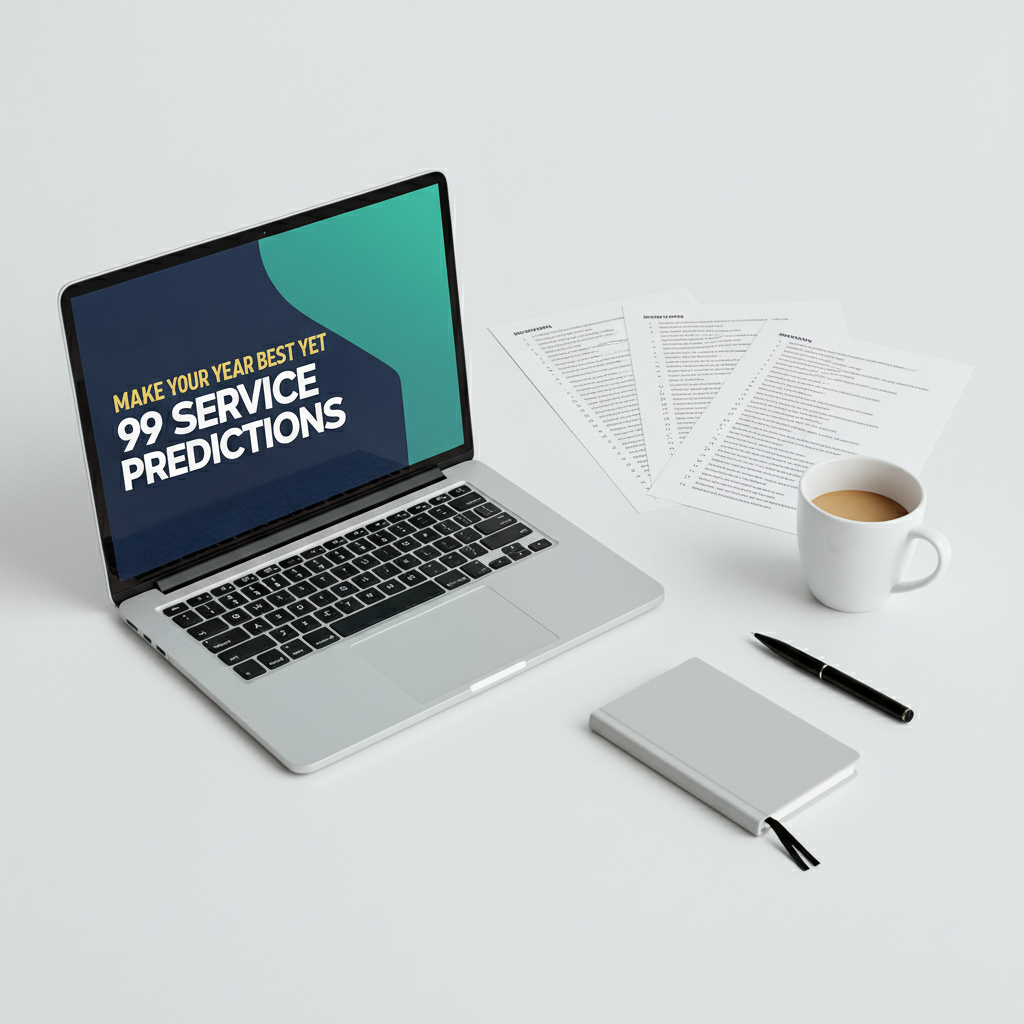
I've built something called the 99 Services List—it's a breakdown of specific, productizable services that small operators can deliver profitably using AI. The services that clients actually need and are willing to pay for right now.
And if you want to go deeper on this shift—how to position yourself, what skills matter, how to actually build something on the winning side—subscribe to the newsletter. I'm covering this all year because it's moving fast and most people are not paying attention.