So I let an AI website builder handle my entire site rebuild.
Not like — help me write some copy. I mean a full migration from WordPress to Astro. AI agents doing the work. No developer touching it.
And I shipped it without auditing a single thing.
A few weeks later, I connected measureu.com to Search Atlas. It handed me a content score of 21 out of 100. My technical SEO was basically in the gutter.
That number stung a little. But here's the thing — the AI made a mess and I had no idea until I ran the audit.
Watch the Full Breakdown
In this video, I walk through the exact audit I ran on measureu.com after the AI migration — including every score, what broke, and how I found the problems before they cost me rankings.
What You'll Learn in This Post
- My overall SEO diagnostic score came in at 65/100 — not terrible for zero human QA, but technical SEO was a disaster
- Content score was 21/100, mostly due to missing page titles and meta descriptions the AI skipped
- LLM visibility score of 30/100 across five AI engines, with 128 citations — meaning when I do show up, I show up well
- The “agent checking agent” workflow is probably how quality assurance works going forward
Table of Contents
- Why I Trusted an AI to Build My Site (And What Happened Next)
- The Technical SEO Disaster Hidden Beneath
- Running an AI SEO Audit: Agent Checking Agent
- LLM Visibility — The Number Your SEO Tool Isn't Tracking
- The All-in-One Platform Value
- Who This Is Actually Built For
- Here's Where I Landed
- Your Next Steps
Why I Trusted an AI to Build My Site (And What Happened Next)
I've been in digital marketing for over 20 years. Built and sold an 8-figure agency. Spent the last decade teaching marketing analytics full-time.
I know how to audit things.
And yet — I handed my entire website rebuild to an AI agent and just… trusted it.
The promise of Astro was that it's faster, cleaner, better for SEO. And AI was supposed to handle the migration details. What could go wrong.
Here's what nobody tells you about AI-built sites:
- The agent does a LOT right
- But it doesn't tell you what it quietly skipped
- Missing page titles, thin content sections, technical stuff that used to work in WordPress that just didn't carry over
You don't find that out until something breaks or rankings drop.
I wanted a way to catch that BEFORE it became a problem.

Quick disclosure: Search Atlas is sponsoring this video. AND I tested it on my live site. Not a demo account, not a fake domain. Real data, real scores, real problems. That's the only way I'll do a sponsored video.
The Technical SEO Disaster Hidden Beneath
The first thing I did was run the AI SEO diagnostic.
65 out of 100.
Honestly — not terrible for a site that was just rebuilt by an AI with zero human QA. But here's where it gets interesting.
My authority score came back high. That makes sense — I've been building this domain for years.
But technical SEO? A disaster.
UX, content structure — also in rough shape.
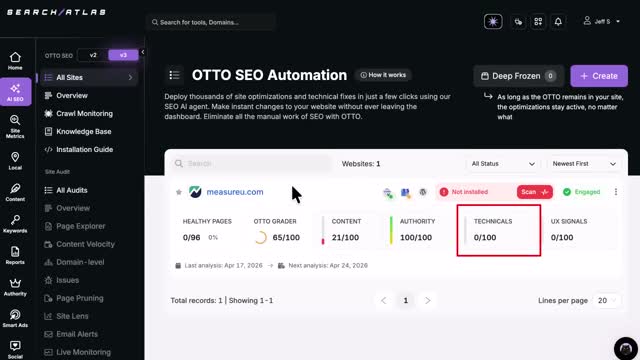
And that's the thing about AI-built sites nobody warns you about. The stuff that's VISIBLE looks fine. It's the structural stuff underneath that quietly falls apart.
My content score came in at 21 out of 100.
When I dug into WHY — it was mostly missing page titles and meta descriptions.
Some of those pages were things I don't care about. Staging content, internal pages, stuff that shouldn't be indexed. But enough of them were real pages that needed fixing.
And Search Atlas didn't just flag the problem. It generated the replacement titles for me. I could either:
- Take those suggestions and feed them to my agent
- Or deploy them directly from inside the platform
That last part matters. Because of how they've built their Cloudflare integration — it can push changes directly to your site.
I'm someone who's always trying to modernize my tech stack. The fact that this product isn't just TELLING me what's broken — it's offering to FIX it — that changes how you think about Search Atlas in your workflow.
Running an AI SEO Audit: Agent Checking Agent
After I saw the diagnostic scores — I went straight to Atlas Brain.
That's their built-in AI agent.
And I typed in the most honest question I could think of:
“I just moved to Astro from WordPress. What do I need to fix still?”
What it did next is what got my attention.
It didn't just pull from a knowledge base and give me a generic WordPress-to-Astro migration checklist. It went through my site. Scanned it, cross-referenced the diagnostic data, and came back with specific issues tied to MY domain.
That's a different experience than asking ChatGPT the same question.
ChatGPT is going to give me best practices. Atlas Brain is looking at measureu.com and telling me what's wrong with THIS site.
That context matters.
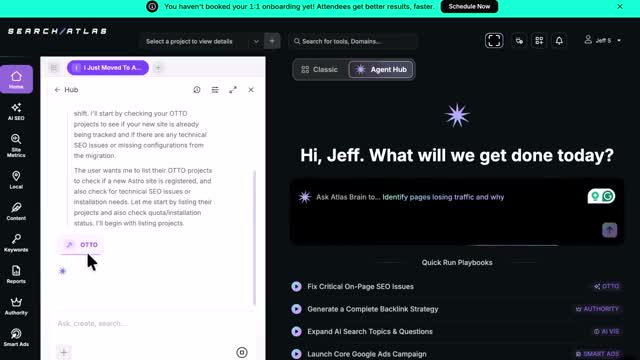
And here's where the accountability angle clicked for me:
- I used an AI agent to build this site
- Now I'm using a different AI agent to audit what the first one missed
Which is probably how this whole thing works going forward.
You're not going to have one agent that does everything perfectly. You're going to have agents checking agents. And having that audit layer built INTO your SEO platform — rather than having to go back to a separate tool — that's a workflow I can see myself using.
What it flagged matched a lot of what the diagnostic already showed:
- Technical issues that didn't carry over from WordPress
- Structural things the Astro migration missed
- The stuff I would have eventually found — probably when rankings started slipping
Instead I found it now, before it cost me anything.
LLM Visibility — The Number Your SEO Tool Isn't Tracking
This is the part I actually came here for.
If you've been following what's happening in search right now — you already know this is the conversation.
It's not just Google anymore.
People are searching (asking questions, really) on ChatGPT, Perplexity, Gemini, Claude — and they're getting answers that never touch a search results page.
Which means your rankings could be fine and your brand could still be invisible.
Most SEO tools aren't tracking this yet. Search Atlas is.

My overall LLM visibility score came in at 30 out of 100. Across five different AI engines.
Now — 30 sounds low. But here's what the breakdown showed:
- High sentiment across the board
- 128 citations — meaning AI engines are referencing my content in their answers
- That's a solid number for a niche B2B site
When I do show up — I'm showing up well.
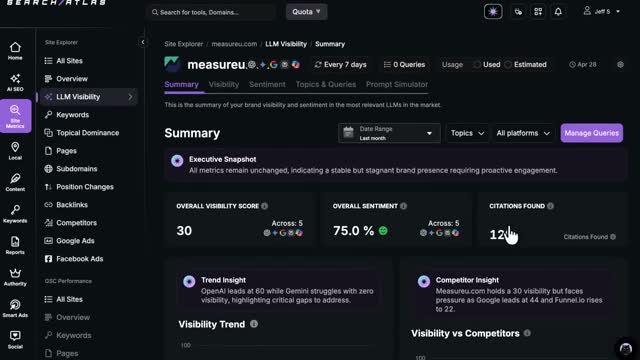
But then there was the Gemini number. Zero.
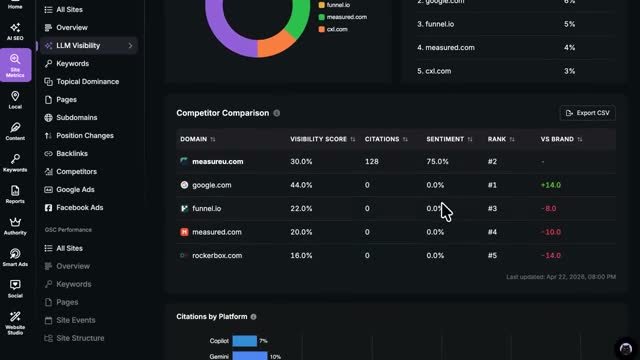
Search Atlas is telling me I have zero presence on Gemini. But that's not exactly true. I know quite well that measureu.com shows up on Gemini answers. I've seen it with my own eyes. So this is likely the result of the queries they ran to test visibility.
What DID feel right was the share of voice comparison.
It's showing me how I stack up against Funnel.io and CXL — two brands in adjacent spaces. And when my site IS getting mentioned by AI engines — I'm outperforming both of them.
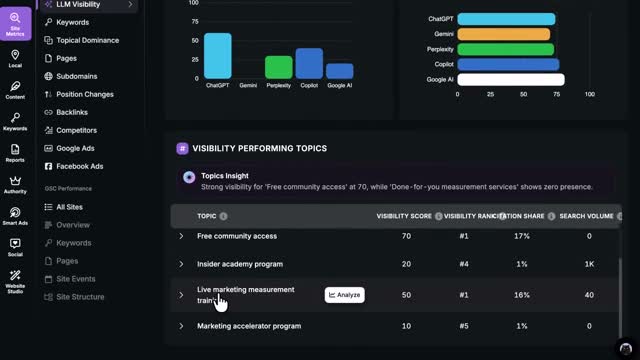
The topics it's tracking me on are mostly product-type queries. Done-for-you measurement services, our Insiders program — that sort of thing. Commercial intent topics.
Which tells me the visibility I DO have is in the right lane.
The All-in-One Platform Value
Let me tell you what Search Atlas is. Because the SEO diagnostic and the LLM visibility stuff — that's the part that pulled me in.
But the bigger pitch is something different.
Search Atlas is trying to be the last marketing platform you open. SEO, AI visibility, Google Ads, Facebook Ads, social — all inside one dashboard.
And I know what you're thinking. Every tool says that.
But I can see they are actually doing it.

It's not just that they HAVE all these features. It's that they're connected to each other:
- My Search Console data is already in here
- My site diagnostics are already in here
- So when I go look at my ads or my social — the context is already there
I'm not stitching data together from five different tabs in five different tools.
They also have a Website Studio. You can generate PPC landing pages directly inside the platform. The workflow is there — generate a landing page, tie it to your campaign, deploy it.
And then there's the Cloudflare piece — which I keep coming back to.
Most SEO tools tell you what to fix and then wave goodbye. You go implement it somewhere else, in some other system, hope your developer gets to it this week.
Search Atlas can push changes to your site because of how the Cloudflare integration works.
For someone like me who's trying to modernize everything — that's not a small thing. That's removing an entire step from the workflow.
Who This Is Actually Built For
So who is this built for?
- Marketing practitioners and agency owners who are sick of managing six different subscriptions
- People who are already deep into their SEO tools — but now need to start tracking LLM visibility — and want that to live in the same place as everything else
- Anyone running a lean team who wants ONE platform that handles the research, the audit, the visibility tracking, and the deployment
It's not perfect — the Gemini data gave me pause — and some of the ads features need more setup than I had time for.
But the core SEO plus AI visibility combination — on a live site, with real data — that part worked.
Here's Where I Landed
I came into this test with one question:
Did the AI actually do a good job rebuilding my site?
And the honest answer is — kind of.
The bones are solid. Domain authority is strong. The migration preserved most of what mattered.
But the details? Missing titles, weak content scores, technical gaps from the migration — those were real problems. And I found them because I ran this audit. Before anything broke.
That's where Search Atlas came in for me.
It's not that any single feature blew me away. It's that I got the SEO audit, the LLM visibility score, the competitor comparison, AND the AI agent — in one session. On my own site. Without switching tools once.
For someone running a lean operation — that's a real time argument.
Your Next Steps
If you want to run this same audit on your own site:
- Connect Search Console first — that gets your baseline data flowing
- Go straight to the LLM visibility tab — that number alone will tell you something most of your competitors still don't know about themselves
- Run the AI diagnostic — see what your AI builder (or your developer, or your past self) quietly skipped
- Ask Atlas Brain a specific question about YOUR site — not generic best practices, but what's actually wrong with your domain
Keep Going
Are you tracking your LLM visibility right now? Do you know if ChatGPT or Gemini are mentioning your brand?
Because here's the thing — most marketers are still treating SEO like it's 2022. Rankings, backlinks, technical fixes. And those things still matter.
But if you're not watching how AI engines are talking about you — or NOT talking about you — you're ignoring a channel that's growing every month.
If you want help building a measurement strategy that covers both traditional SEO and AI engine optimization, check out our services — we help marketing teams get this right.