Tired of that sinking feeling after sending a proposal—wondering if you just left thousands on the table?
You're not alone. Most service providers are bleeding profit margins without even knowing it. I'm talking $40,000 to $50,000 a year, quietly disappearing because nobody ever gave them a real system for pricing.
I know because I was one of them.
The Story That Changed Everything (And Why My Business Partner Laughed at Me)
My business partner told me something a few years back that I still think about.
We were talking about the old days—back before I joined the business as a partner. He looked at me, completely straight-faced, and said: “We used to laugh at your rates. We thought it was hilarious.”
He wasn't being cruel. He said it the way you'd say something genuinely funny—a little fond, a little baffled. In the moment, I laughed too.
Then I got home and started doing the math.
I built a calculator. I pulled up every service I'd been offering them, cross-referenced what I was charging against what my actual costs were, and figured out what I should have been charging.
The amount of money I lost was embarrassing. And the worst part? They weren't wrong to laugh.
I'm Jeff Sauer. 20 years in marketing. 8-figure agency exit. Thousands of proposals written—the later ones were priced perfectly, but in the beginning? Not even close.
Watch the Full Breakdown
What You'll Learn in This Post
- The “charge more” advice most gurus push can actually collapse your business
- With AI compressing delivery time, fair rates at 3x output beat premium rates at the old pace
- The P.R.I.C.E. Method is a 5-step pricing strategy that shows you exactly what to charge
- Most agencies are leaving $40K–$50K annually on the table without knowing it
Table of Contents
- Why Most Service Providers Get Pricing Wrong
- Why “Charge More” Is Bad Advice
- The P.R.I.C.E. Method: A 5-Step Pricing Strategy
- What's Your Pricing Gap?
Why Most Service Providers Get Pricing Wrong (The $45/Hour Story)
The Employee Brain Anchor
Here's the thing about gut-feel pricing: it doesn't feel like a problem when you're doing it.
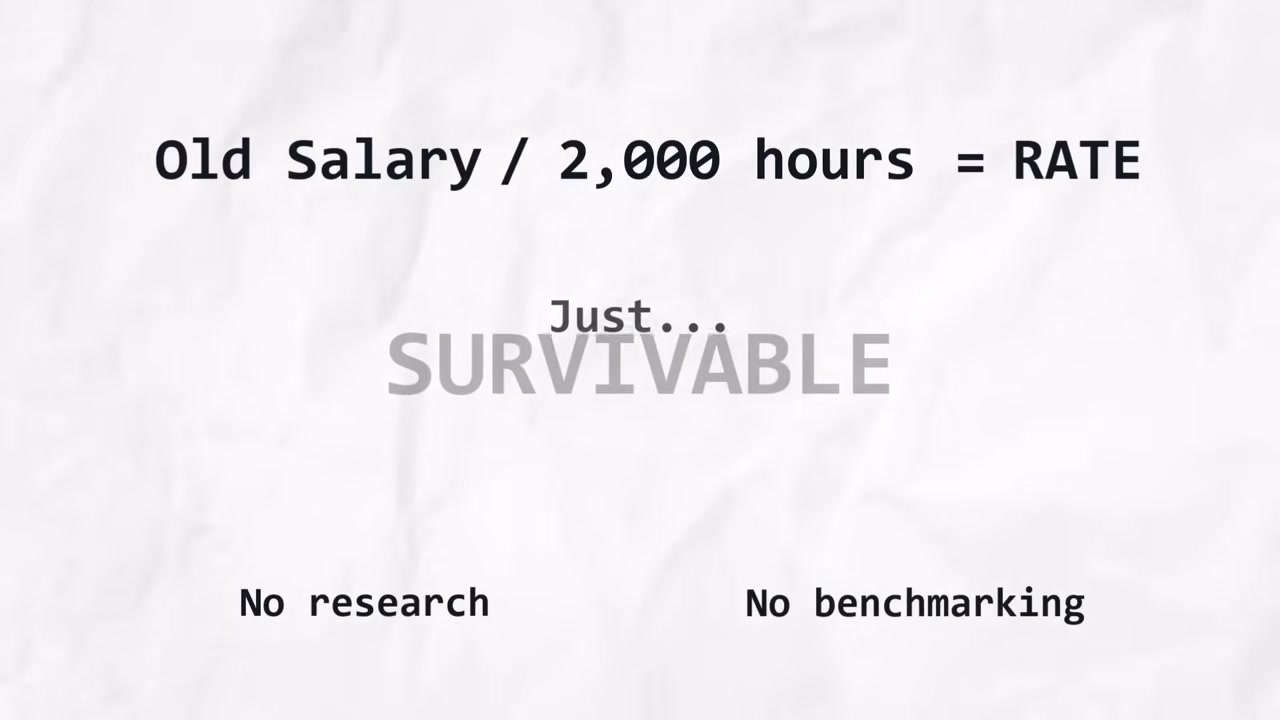
I charged $25-45 an hour when I started out. My entire pricing logic was: take what I used to make as an employee, divide by 2,000 hours, and call it a rate.
That was the whole system. No research, no benchmarking—just “this number feels survivable.”
What “They Laughed at My Rates” Actually Meant
My first big client—the agency I ended up joining as a partner—I worked up the nerve to ask for $45. I was practically shaking through the meeting, convinced they'd push back, ask me to justify myself, tell me I was reaching.
They said yes without blinking.
And I remember feeling so relieved that I completely missed what that moment was telling me: they'd already decided I was worth more than $45 before I ever opened my mouth.
My only reference point was my old salary. I hadn't thought about margin at all. I hadn't factored in overhead, revision cycles, the hours I'd spend on calls and emails I'd never bill for. I wanted to get paid and do good work.
That was my entire financial model.
And that's how most people price when they first go out on their own. You inherit your employee brain. You think in terms of what someone used to pay you. And that anchor quietly costs you money for years before you understand what's been happening.
Years later, my business partner confirmed it. “We laughed. We thought it was hilarious.” Because I was delivering something worth far more than what I was asking for, and I had no framework to know that.
Why “Charge More” Is Bad Advice (Even If You're Undercharging)
So here's where I say something that might sound strange coming from me.
“Charge more” is bad advice.
I know. I just spent several paragraphs telling you I was undercharging by 4x. And now I'm saying the standard raise-your-rates message is wrong?
Stay with me.
The Hidden Costs of Premium Pricing
The guru version goes like this: you're undervaluing yourself, you're afraid to ask, just add a zero, your ideal clients will pay it, confidence is the whole game.
And look—parts of that message were useful to me at certain points. I did need to charge more. But “charge more” as an actual pricing strategy has real consequences that don't get discussed.
When you push rates to the ceiling:
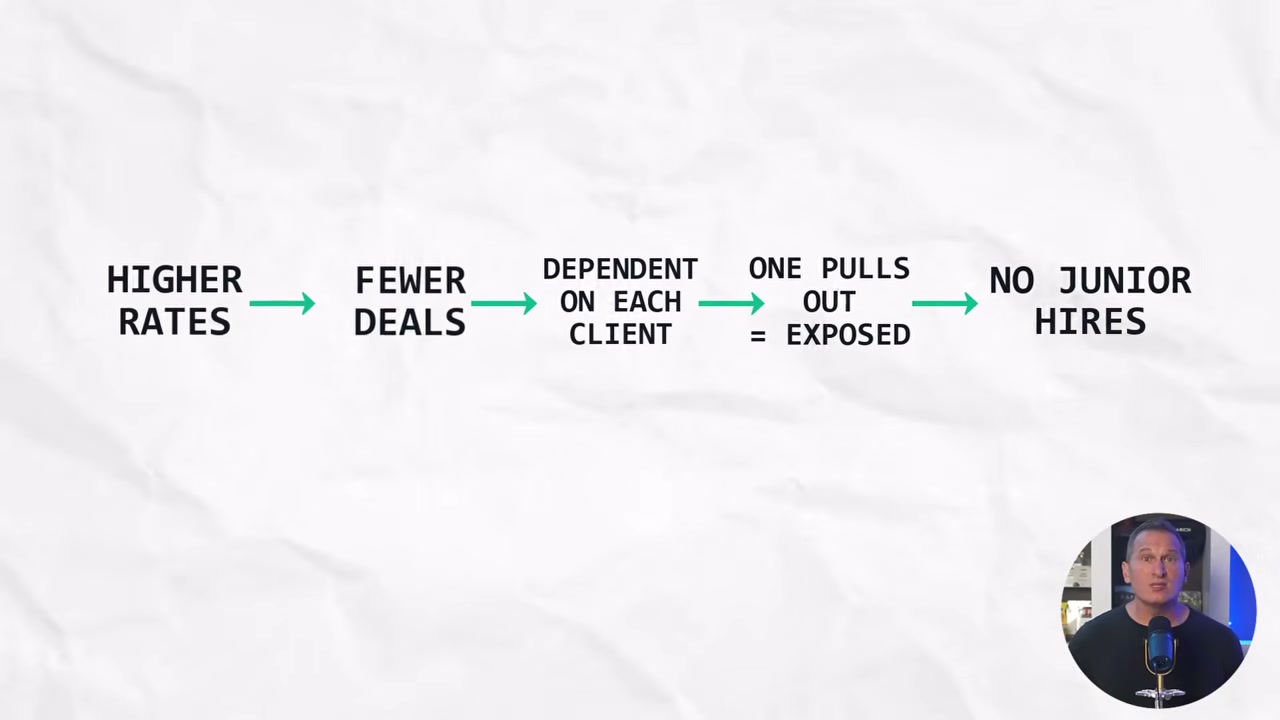
- You win fewer deals
- You're completely dependent on each one you do win
- One client pulls their budget and you're exposed
- There's no room to absorb a mistake
- You can't bring on junior people because the training overhead doesn't pay for itself at your “premium” rate
So you end up doing everything alone, stretched thin, and one bad quarter is all it takes.
I've watched genuinely good agencies collapse because they priced for best-case scenarios and had nothing underneath them when conditions shifted.
How AI Changes the Pricing Strategy Game
And here's what nobody in the charge-more camp is accounting for right now: AI is compressing delivery time.
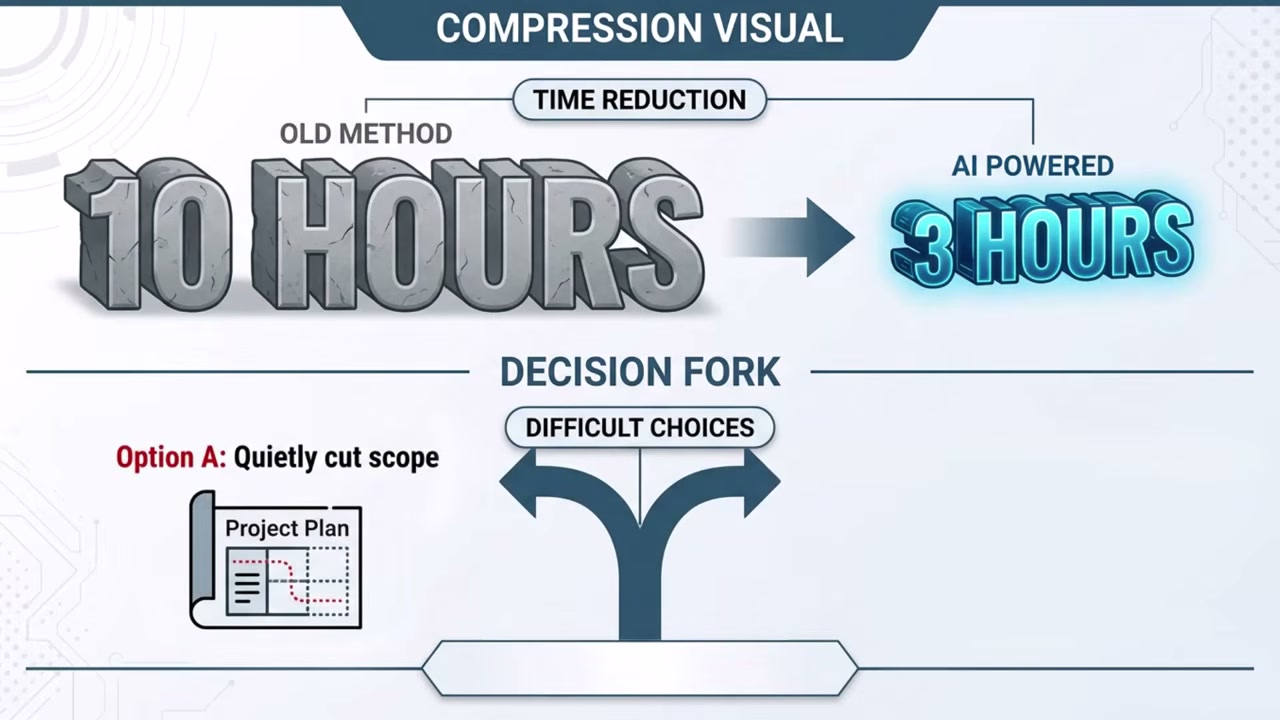
Work that used to take me 10 hours takes 3. So what do you do with that?
If you're billing at premium rates, you're either quietly cutting scope to hide the efficiency gain, or you're having a very uncomfortable conversation with a client who's wondering why the invoice didn't move.
Try holding premium rates while AI is making delivery faster and cheaper across your whole category—you're going to get absolutely crushed by anyone willing to compete at fair rates with better throughput.
My take on this—and this is the premise the whole P.R.I.C.E. Method is built on—is that you should charge what the work is worth. What the market supports. What your reputation can justify. What's genuinely fair given the value you're delivering.
Because with AI doing more of the work, a fair rate at three times the output beats a premium rate at the old pace. You take on more clients, better clients, and you're not hostage to any single one of them.
That's the real opportunity here—not squeezing each deal harder, but running a more profitable operation at rates people are genuinely happy to pay.
Charge correctly.
The P.R.I.C.E. Method: A 5-Step Pricing Strategy for Service Businesses
Earlier this year, I built the 99 Services Framework out of 2,000-plus pages of research on what services are actually worth and which ones are going to survive the AI shift. And I took all of those services and applied my 5-step service pricing system I wish I'd had from day one.
It's called the P.R.I.C.E. Method.
P — Profit Margins (Know What You Actually Keep)
I want to be specific here because this is where most people's math completely falls apart.
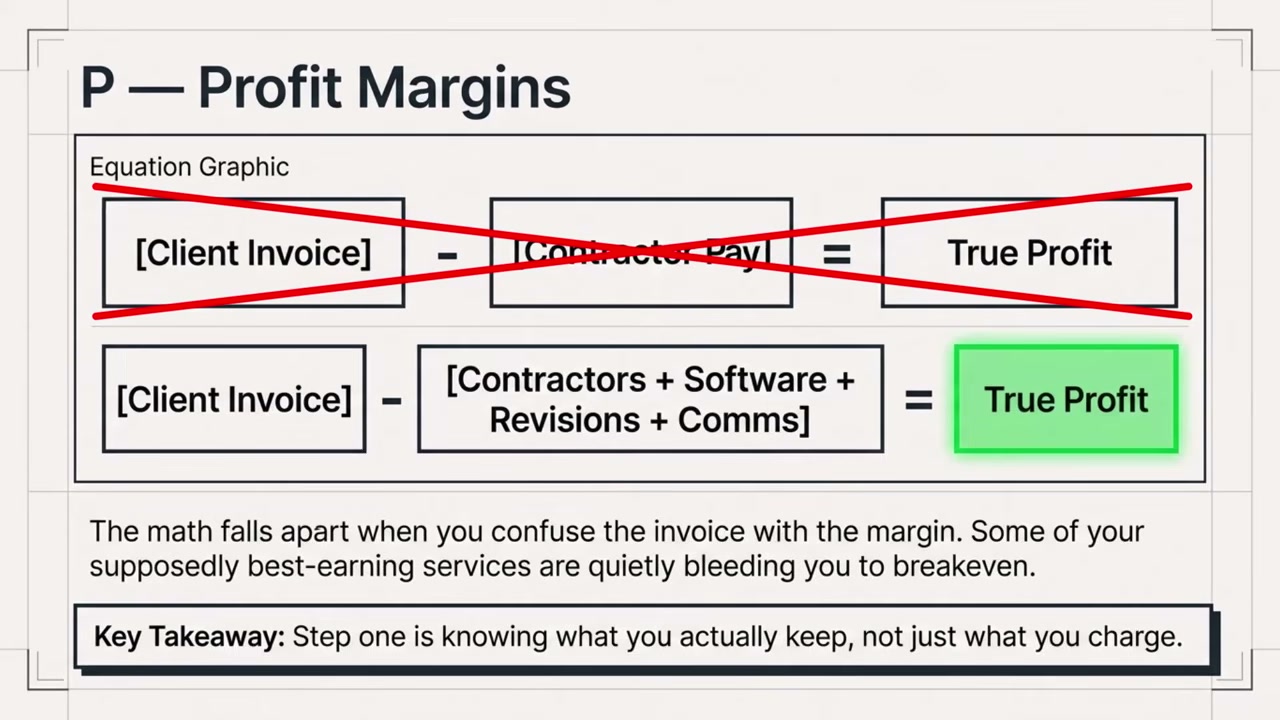
They look at what a client pays, subtract what they paid a contractor or employee, and the difference feels like profit.
It is not profit.
When I finally ran actual margin calculations per service—factoring in software costs, revision cycles that never made it onto the invoice, management time, the communication overhead that nobody ever bills for—some of my supposedly best-earning services were close to breakeven.
The ones I was proudest of selling were bleeding me quietly.
Step one of this whole system is knowing what you actually keep. Not what you invoice. What's left after everything.
R — Rate Card (Why 3 Tiers Close More Deals)
That's where the rate card structure comes in.
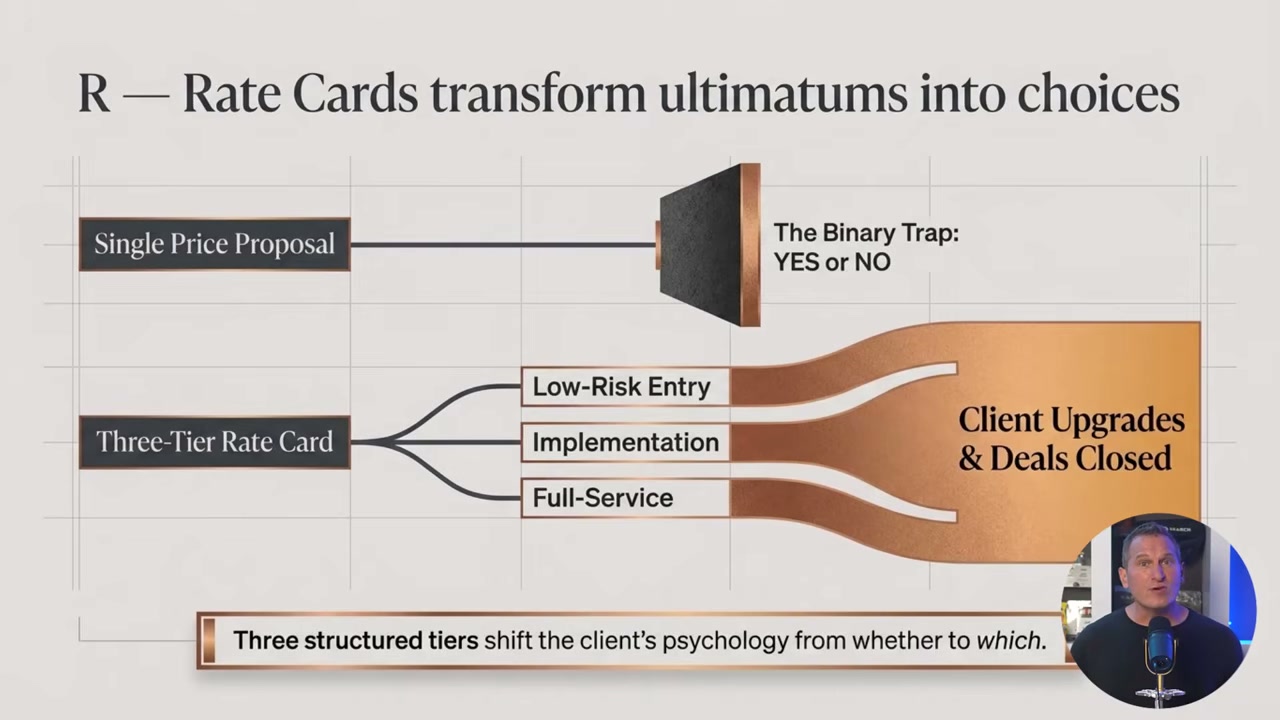
Three tiers: low-risk entry point, implementation, and full-service.
Here's why this closes more deals than a single price. Put one number in front of a client and their whole decision is yes or no. Add two more tiers and suddenly the question isn't whether—it's which.
That reframe alone moves more deals forward before you've said another word about value.
- The low-risk tier gets someone in the door
- The middle tier is where most engagements land
- The full-service option is for clients who want everything handled—and more of them take it than you'd expect, because you gave them the option to
I go much deeper on structuring each tier inside the full P.R.I.C.E. Method and my book Service Stacking, but the core: options close more deals than ultimatums.
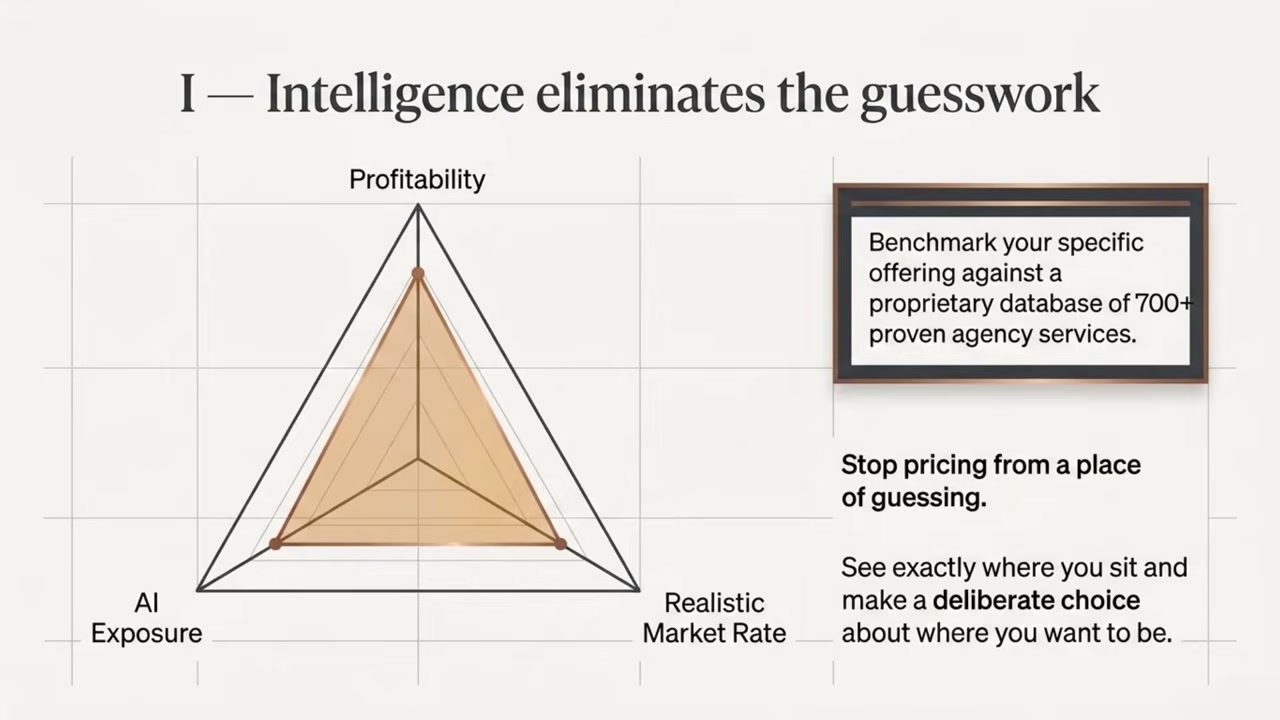
I — Intelligence (The 700-Service Benchmarking Database)
This piece changes how you walk into any pricing conversation.
I spent the better part of a year building a database of 700-plus services that agencies and freelancers actually sell—each one scored for profitability, for realistic market rates, and for how much AI exposure that service has going forward.
When you benchmark your service pricing against that database, you stop guessing about whether your rates make sense. You can see exactly where you sit and make a deliberate choice about where you want to be.
That's a completely different place to operate from than “I feel like I should charge more.”
C — Client List (Who You Sell To Matters as Much as What You Charge)
Who you sell to matters as much as what you charge.
If you're taking every engagement that comes in, you will always have at least one client grinding your profit margins down and making delivery harder than it needs to be. Usually more than one.
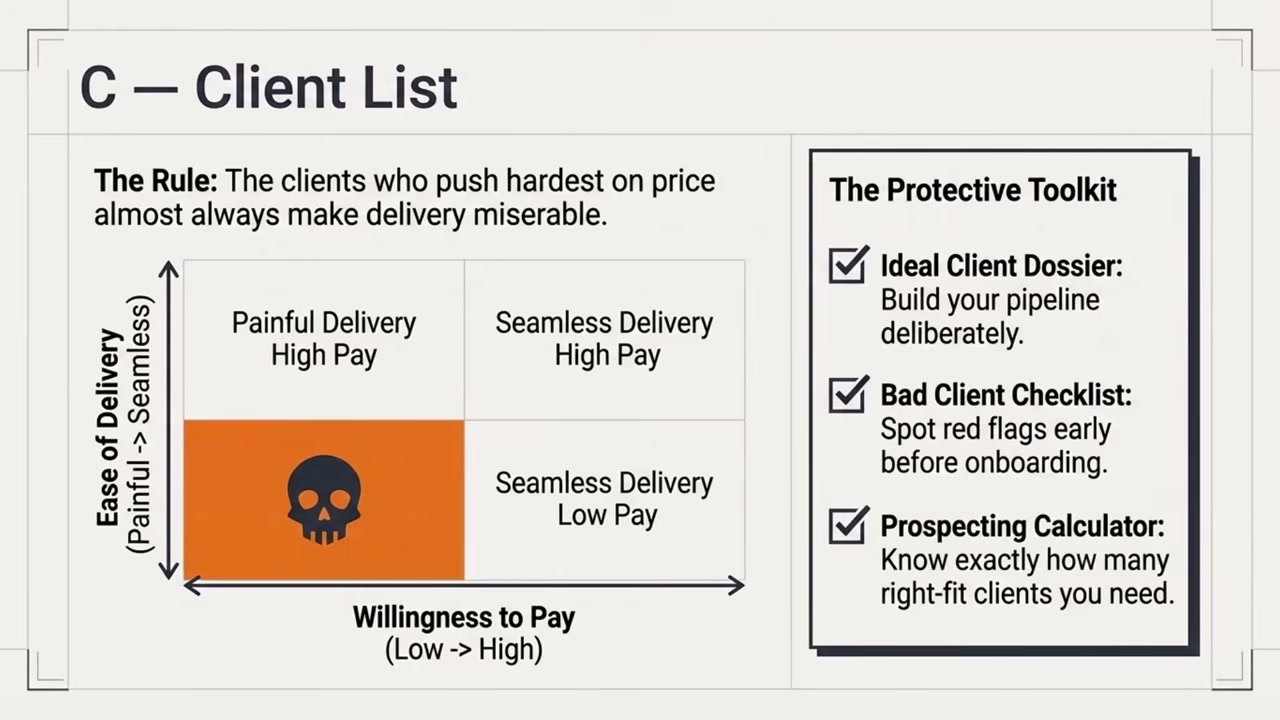
The Client List step has three components:
- Ideal Client Dossier so you know exactly who you're building your pipeline around
- Bad Client Checklist for spotting the warning signs before you're already two months into a nightmare
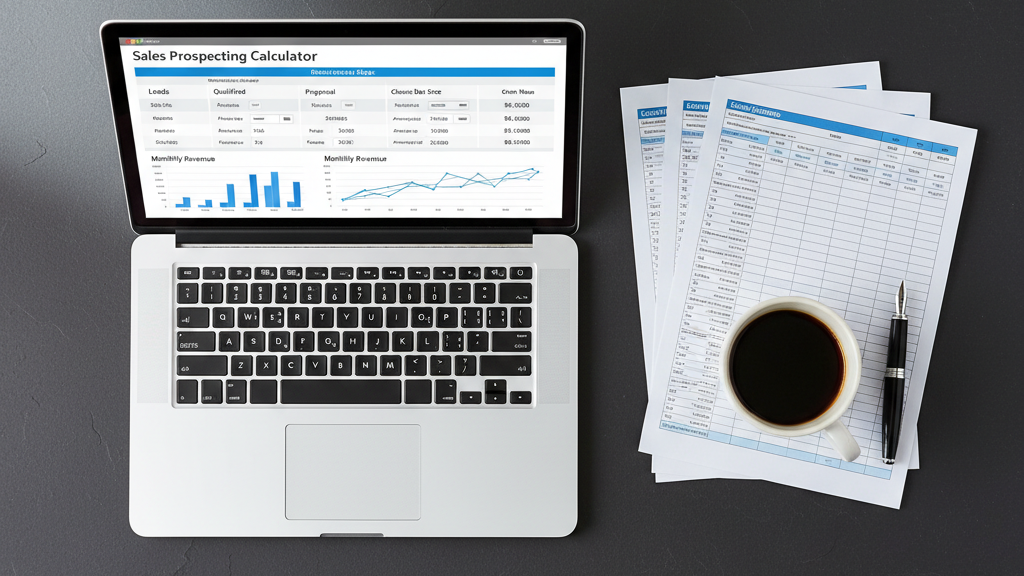
- Prospecting Calculator that shows you how many right-fit clients you actually need to hit your revenue targets
The clients who push hardest on price are almost always the same ones who make delivery miserable. Getting clear on who belongs in your pipeline—and who doesn't—is part of how you hold your rates when it counts.
E — Evidence (How to Hold Your Rates in Sales Conversations)
This is the piece I wish I'd built before almost anything else.
Most people cave on price in a sales conversation for one specific reason that has nothing to do with their rates being too high: they walk in with no evidence of their work being effective. No data, nothing to benchmark against, no framework for why the number is what it is.
So the moment a client pushes back, there's nothing to stand on.
The Evidence step has three pieces:
- Sales Scorecard helps you qualify deals before you've put a single hour into proposal writing—so you're not pouring effort into opportunities that were never going to close
- AI Prompt Pack generates the supporting materials that make your pricing feel data-backed rather than gut feel
- FOLO Framework (Fear Of Losing Out)—that's how you structure the conversation so that walking away from your proposal starts to feel like the riskier move to the client
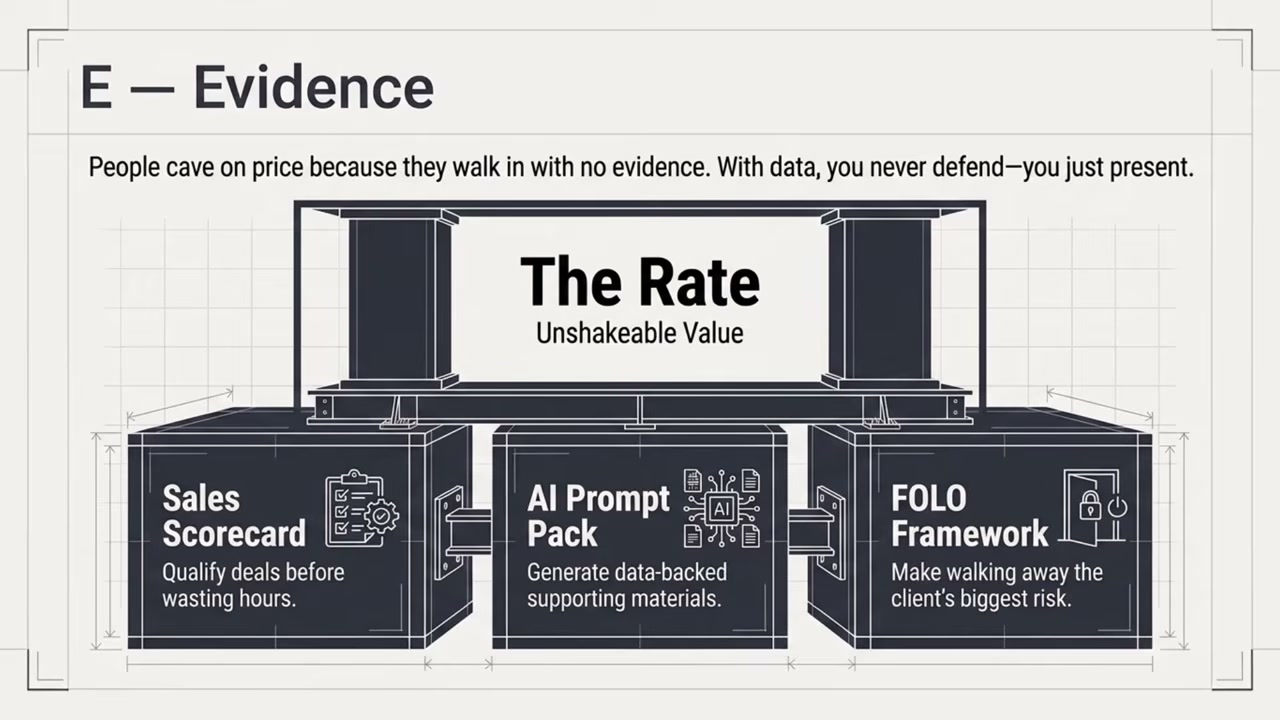
When you have evidence, there's nothing to defend. You're presenting your rates.
What's Your Pricing Gap?
So that's P.R.I.C.E.—Profit Margins, Rate Card, Intelligence, Client List, Evidence.
Five steps. Each one with a tool. And all of it leads to one number: your Pricing Gap. The annual revenue you're leaving on the table right now, calculated from your actual services, your real costs, and how long things actually take you to deliver.
Mine was embarrassing the first time I ran it. My guess is yours will be too.
Ready to find out what you're leaving on the table?
The full P.R.I.C.E. Method includes the calculator, the rate card templates, the 700-plus services database, the Ideal Client Dossier, the Bad Client Checklist, the Sales Scorecard, the AI Prompt Pack—everything.
You know the framework now. Go put your actual numbers in and see what the tool says.
Get the Pricing Gap Calculator →