Tired of finishing an AI project for a client, only to watch them disappear and never hear from them again?
You deliver real value. They get results. And then… nothing. You’re back to square one, hunting for the next project, burning through your pipeline just to stay afloat.
Here’s the thing: I’ve been splitting my AI clients into two buckets, and once I saw the difference in how each bucket performs, it changed how I price, how I onboard, and which clients I actually want to take on.
One type needs you for a few months, then they’re gone. Chasing more of them will burn you out.
The other type wants marketing automation AI in their business but doesn’t want to push the buttons themselves. Those clients stay.
That’s where the AI Enablement Partner model comes in, and I’m going to show you exactly how to structure the 90-day engagement that turns the second type into long-term revenue.
A Quick Note on My Background
I’m Jeff Sauer, and I’ve been in digital marketing for over twenty years. My partners and I built an agency, scaled it to eight figures, and exited. After that, I spent a decade teaching marketing full-time, in courses, coaching and frameworks, and I’ve created more than two thousand pages of research on where service businesses are heading.
Right now, a big part of what I do is coach consultants and small agencies on how to use AI to grow without adding major headcount. And I work directly with AI clients myself. I’ve had both kinds of clients I’m about to describe on my roster, so everything here comes from firsthand experience.
Watch: The Full AI Enablement Partner Breakdown
In this video, I walk through the complete framework for identifying which clients will stick around and how to structure your first 90 days:
Key Takeaways
- The two distinct AI client types and why only one builds a sustainable business
- Why traditional “retainer” positioning fails for AI work
- The 90-day timeline that proves your value before asking for ongoing commitment
- How to price AI Enablement partnerships ($2K to $15K per month)
Table of Contents
- Why Traditional Retainers Fail for Marketing Automation AI
- The Two Kinds of AI Clients (And Which One Actually Pays Long-Term)
- Introducing the AI Enablement Partner Role
- The 90-Day Method: How to Structure Your First Engagement
- Why Long-Term Clients Keep Paying
- Pricing Your AI Enablement Partnership
- The Unexpected Upside You Didn’t See Coming
Why Traditional Retainers Fail for Marketing Automation AI
Here’s the problem with pitching a client on a long-term retainer these days.
The word “retainer” implies you’re being retained monthly for your expertise. Maybe you built something and now you’re maintaining it.
But AI work isn’t like that. The build phase never really ends. There’s never a finished system you just maintain.
The marketing automation AI system you helped a client build three months ago? It may already be the wrong system for today. It could have been built on an AI model that was recently retired. And it breaks the day that model goes away.
You keep track of these developments every day. But your clients aren’t in the weeds of the technology. They’re busy building a business. They’re not reading Anthropic’s model announcements. They don’t know Claude Opus was deprecated or that GPT-4o just got a major update.
The ground keeps moving with AI underneath these solid company foundations. Someone has to watch it.
And you can’t take your eye off the ball either. Long-term clients become long-term ex-clients quickly if you can’t keep the value coming.
One survey of agency professionals found that about a third of clients who cancel an ongoing engagement cite lack of perceived value over time as the reason. It’s rarely about the price. They stopped seeing the value they were paying for.
That’s what we’re fixing today.
The Two Kinds of AI Clients (And Which One Actually Pays Long-Term)
The DIYer
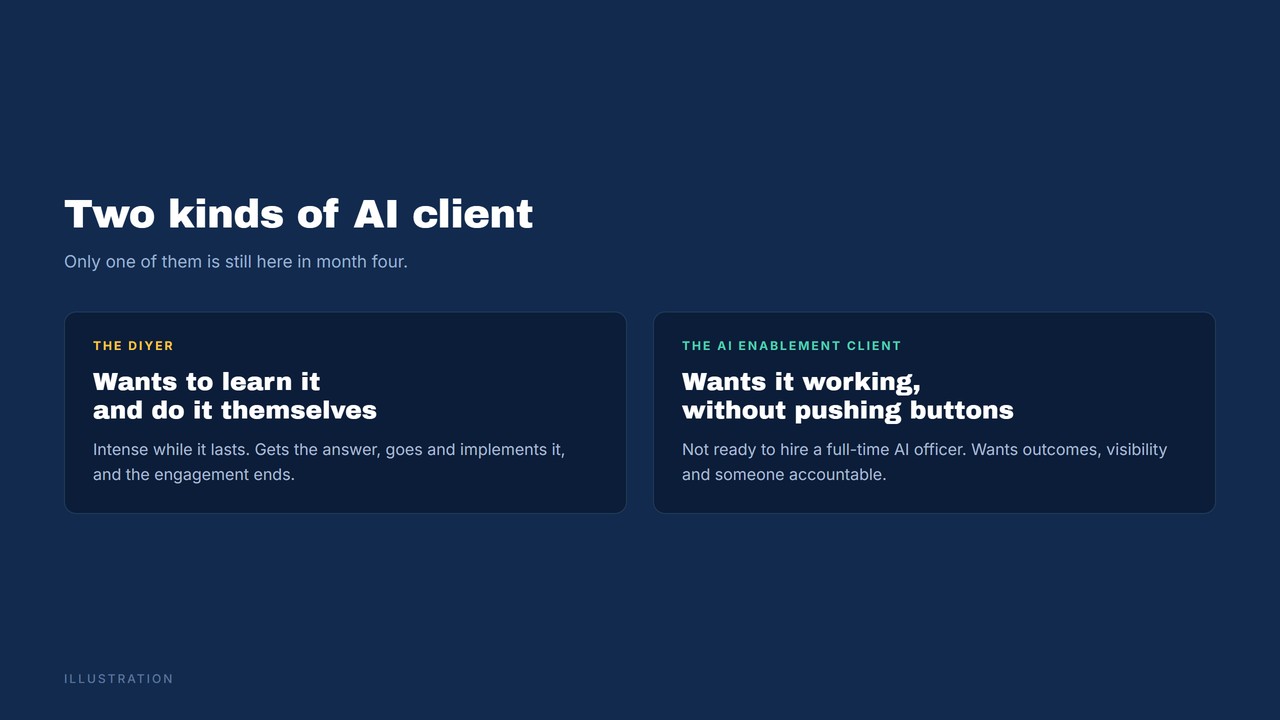
The first group is what I call the DIYer: they want to do it themselves.
This person wants to get into AI themselves but has been too busy working on their business to jump in. Maybe they’ve heard about Claude Code, OpenAI Codex, or Grok, or even heard how I’ve automated several roles in my business using AI.
Either way, they’re inspired to figure it out and get their hands dirty. They just need someone to light the fuse. They need a muse, a source of inspiration, someone who can point them to the right thing and get them moving.
Getting the wheels in motion can take ninety days. And once they’re moving? They’re gone.
They get the answer they came for, go implement it, and you don’t hear from them again.
About half the people I coach are exactly this. They’re intense while it lasts because they’re asking a lot of you. Every question they have, every rabbit hole they want to go down, they’re pulling it from you.
It’s like a rental transaction: they get real value, but it doesn’t compound into long-term revenue for your business.
The problem? If you build your whole business chasing these clients, you’re always starting over. And you burn out fast.
The AI Enablement Client
The second group is different. And honestly, these are the best clients I’ve ever had, in AI work or any other work.
This person knows AI is powerful. They’ve seen enough to believe it can save them serious time or get projects done that were never going to happen with their existing team.
But they don’t want to push the buttons themselves.
And they’re not ready to hire a full-time chief AI officer. That’s a huge commitment: a salary, benefits, someone who owns a whole function.
They want AI working in their business, and they want someone accountable for making that happen.
These clients last. They stay because the value keeps arriving every month.
Introducing the AI Enablement Partner Role
So what do you actually call this role when you’re talking to a client?
I’ve landed on AI Enablement Partner, or fractional AI enablement partner if you want to be precise.
The word “fractional” tells the client exactly what they’re getting: the expertise of someone who does this full-time, at a fraction of the cost and commitment of hiring you as a full-time employee or advisor.
No expensive hire. No benefits. No org chart headache. Just someone who shows up, gets the work done, and reports back.
They’re not trying to learn everything you know. They want outcomes, they want visibility into what’s happening, and they want someone who is accountable.
Here’s the key distinction that separates this from traditional retainer work:
A retainer is a fee for availability.
An AI Enablement Partner is a fee with accountability.
While you bill monthly like a retainer, the positioning is completely different. You’re not waiting around for them to need you. You’re actively delivering, tracking, and reporting on AI implementations that move their business forward.
The 90-Day Method: How to Structure Your First Engagement
The biggest mistake I see people make is thinking they can jump right in, drop a bunch of AI lingo, and the client is “enabled.”
You have to meet them where they are.
And the realistic timeline for getting anything real off the ground is ninety days.
One call isn’t enough. Even thirty days isn’t enough time.
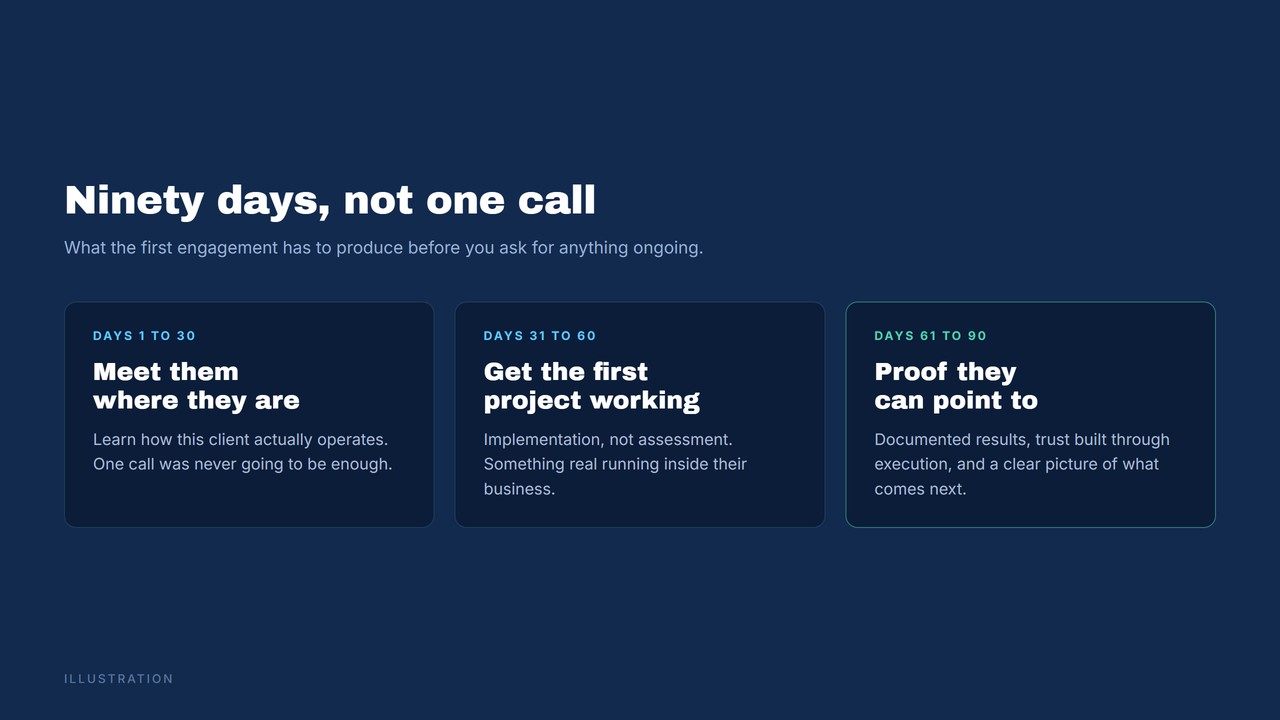
You need ninety days to:
- Get the first real project working
- Learn how this particular client operates
- Build enough trust that they’ll actually follow through on what you recommend
At the end of ninety days, one of two things happens:
- The client has what they came for, and they’re off to the races. That’s fine, that’s the DIYer. Let them go.
- They’re getting results, they can see the value, and they want to keep working with you.
But you can’t shortcut the ninety days. And you shouldn’t promise you can.
What Makes This Different From a “Discovery Phase”
The 90-day structure isn’t about assessment and recommendations. It’s about implementation and proof.
By day 90, you should have:
- At least one working system in their business
- Documented results they can point to
- A clear picture of what comes next
- Trust built through execution, not just planning
That last one matters. Trust built through execution is what converts DIYers into long-term clients. Some people think they want to do it themselves until they see what it actually takes. The 90 days gives them that visibility.
Why Long-Term Clients Keep Paying (And How to Make Value Visible)
What makes this AI business model work long-term is simple: you’re getting paid to stay ahead.
Every month, new techniques arrive. Models change. Tools update. Something gets deprecated. Something better comes out.
You’re already tracking all of that because it’s your job, or at least a hobby.
Your client isn’t tracking any of it. And they don’t want to.
The Monthly Value Loop
Here’s the practical piece that keeps the relationship healthy, even in a quiet month:
Get on calls with them to figure out what challenges they’re facing. What decision do they need to make in the next thirty days that’s stressing them out? Can you help them figure it out?
Share what you’re working on for them and how it’s going. This is how you make the value visible.
Visible value is what prevents the “I’m not sure what I’m paying for” conversation that kills ongoing engagements.
A Real Example: The To-Done List
Let me tell you about one of my long-term clients.
They came to me needing a dashboard. So I built the dashboard.
Then the dashboard told them they needed more leads. So I set up a CRM.
Then the CRM showed the website wasn’t converting. So we worked on conversion rate optimization.
Each project came out of the last one. We just kept working in sprints. Their to-do list became a to-done list, and it got done with me.
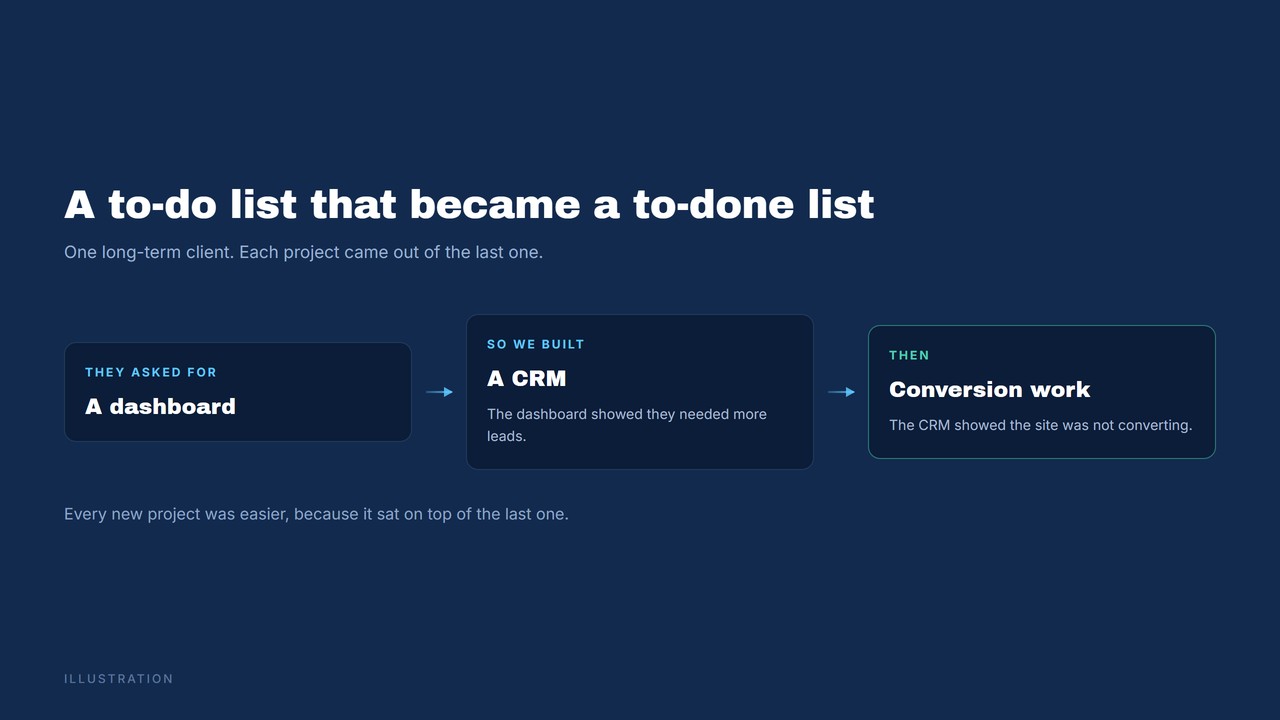
And every new project got easier to build because it sat on top of everything we’d already built together.
The Cost Advantage Working in Your Favor
The other thing working in your favor is cost.
Whatever you’re delivering, whether that’s AI workflows, automations, or projects that used to take a full team or a big agency, you’re delivering it at a fraction of what it would have cost before.
That fraction is why clients are doing this now instead of waiting.
They’re finally getting to projects that were always on the list and never got done. The budget was never there before. With AI, it suddenly is.
Pricing Your AI Enablement Partnership
So what does this actually pay?
In my view, a client who’s working with you as their AI Enablement Partner, where you’re doing the work, staying ahead, and reporting back, is worth somewhere between $2,000 and $15,000 a month.
The range is wide because the scope varies. A solopreneur who needs one automation workflow is different from a company that wants you embedded in multiple departments.
If you build a roster of five to ten of these clients and keep refilling as engagements wrap, you have a real business.
It’s not complicated. But it requires you to position yourself into a new role most companies don’t have in place.
Quick Math
| Clients | Monthly fee each | Monthly revenue | Annual revenue |
|---|---|---|---|
| 5 | $3,000 | $15,000 | $180,000 |
| 7 | $5,000 | $35,000 | $420,000 |
| 10 | $2,000 | $20,000 | $240,000 |
The numbers work. The question is whether you can find and keep the right clients.
The Unexpected Upside You Didn’t See Coming
There’s an upside to this that I didn’t see coming when I started.
Whatever you do in these engagements, whatever you get genuinely good at because you’re doing it for real clients, that can become what you’re known for.
I didn’t go into this thinking I was going to be an AI web developer. But I had a coaching client who needed help with their website, and I worked through it with them. Then I worked with other people who needed the same thing.
And now I get a lot more web development projects than I ever expected, because I’m confident in the results.
That’s why I want you to leave this fired up.
Not just because this is a good AI business model, though it is, but because the work you do in the next ninety days with the right client could be the thing that defines what you’re known for two years from now.
Your Next Steps
Ready to build this? Here’s where to start:
- Audit your current client list. Which ones are DIYers who’ll leave once they have what they need? Which ones want accountability, not education?
- Position your next conversation differently. Don’t pitch a retainer. Pitch a 90-day AI Enablement engagement with specific outcomes.
- Build your monthly value visibility system. How will you show clients what you’re doing and what it’s producing? Figure this out before you need it.
- Pick your price point. Based on your experience level and the client’s scope, where do you land in the $2K to $15K range?
Keep Learning
If you want to stay ahead of this stuff without doing all the research yourself, I send a free newsletter called AI-First Business. It covers what’s changing in AI, what it means for your business, and what to do about it. You can sign up here.
And if you want to go deeper on how to position your AI work so clients understand what they’re buying, watch Stop Selling Hours: Become the AI Consultant Clients Retain. It’s the foundation underneath everything we talked about today.
So which kind of AI client do you mostly have right now? The DIYer who gets the answer and moves on, or the one who wants a partner to stay? Your answer tells you which business you are actually running, and the next ninety days are where you change it.