I have a file on my computer called “drafts I never sent.”
Because for years, I could not figure out how to do my own agency marketing. So I created a list of people who helped me in the past, copywriters, designers, SEO specialists, and drafted emails begging them to come back.
I never sent a single one.
Know that feeling? You're great at marketing for clients, but your own brand sits there collecting dust. And every time you try to fix it, hiring someone new, testing another AI tool, the same thing happens. The work stalls. Or worse, it ships and you hate it.
That's where this changes. I run my own marketing now for my agency, and this post walks you through exactly how I made that happen using AI. Not by finding a magical person. By finally writing down six things I should have documented years ago.
Watch the Full Breakdown
The written version below covers the same ground: why AI drafts keep missing, the three parts every marketing job has, and the six things you have to put in writing before any of it runs without you.
What You'll Learn in This Post
- AI marketing fails because of documentation problems, not AI problems
- Every marketing task needs three parts: Function, Skill, and Gate
- The six components you must write down: trigger, non-negotiables, steps, gates, where facts live, and verification
- The thing that writes the work cannot approve the work
Table of Contents
- My 20 Years of Marketing Experience (And Why It Didn't Help)
- What Changed in Agency Marketing After the Pandemic
- Why Your AI Marketing Fails (And It's Not the AI's Fault)
- The 3-Part Framework Every Marketing Task Needs
- The 6 Things Your AI Needs to Do Your Marketing
- Why the Author Should Never Be the Judge
- How to Apply This to Newsletters, Social, YouTube, and Landing Pages
- Start With the One Marketing Function You Repeat Most
My 20 Years of Marketing Experience (And Why It Didn't Help)
I've spent more than twenty years in digital marketing. Built an agency that made the Inc. 5000 list five times. We sold for eight figures. For a decade after that, I taught this stuff full time.
We had marketing figured out. We knew how to run campaigns, write copy, build funnels, get results.
But as times changed, my own marketing became a disaster. Because the people who did it kept leaving. And every time one left, the work stopped. Not slowed down. Stopped.
I would scramble to find someone new, onboard them, watch them figure out our voice, our audience, our process. Then they'd leave too.
With hindsight, I underestimated how much institutional knowledge lived only in my head. The excuse was always “I can't find good people.” But that wasn't the real problem.
What Changed in Agency Marketing After the Pandemic
Something shifted in the marketing labor market, and I watched it happen up close.
For a few years after the pandemic, marketers could name their price. Demand was everywhere. Good people were flooded, stretched thin, drinking from the fire hose. A lot of those same people are getting out of the industry now. Some burned out, others left because the work changed so much.
The things they built careers on started feeling like commodities to their clients.
It was really hard to find top marketing talent at an affordable price for small businesses like agencies. The excuse was always: I cannot get the people. I cannot find a good copywriter who wants to work with a small shop.
For years that excuse had some truth to it. It doesn't anymore.
Talent is available now in a way it wasn't before. And that's because machines, AI, can do a significant portion of the work. So if your marketing is still not shipping, the old bottlenecks are gone. You need a different approach.
Why Your AI Marketing Fails (And It's Not the AI's Fault)
When I finally started using AI for my own marketing, I thought I'd found the answer.
“Don't hire anyone,” I thought. “Just let AI do the work.”
Those first few years were painful. Drafts that sounded close but weren't quite right. Drafts I had to rewrite from the ground up. Drafts I threw out entirely.
Years ago, the problem was the AI. But that hasn't been a valid excuse for at least 18 months.
The real problem? I never trained AI to market like me.
Here's the thing: if I had hired a junior marketer and handed them the same vague brief I was handing the AI, I would have gotten the same result. A draft that was close but not quite right. That I had to rewrite or throw out.
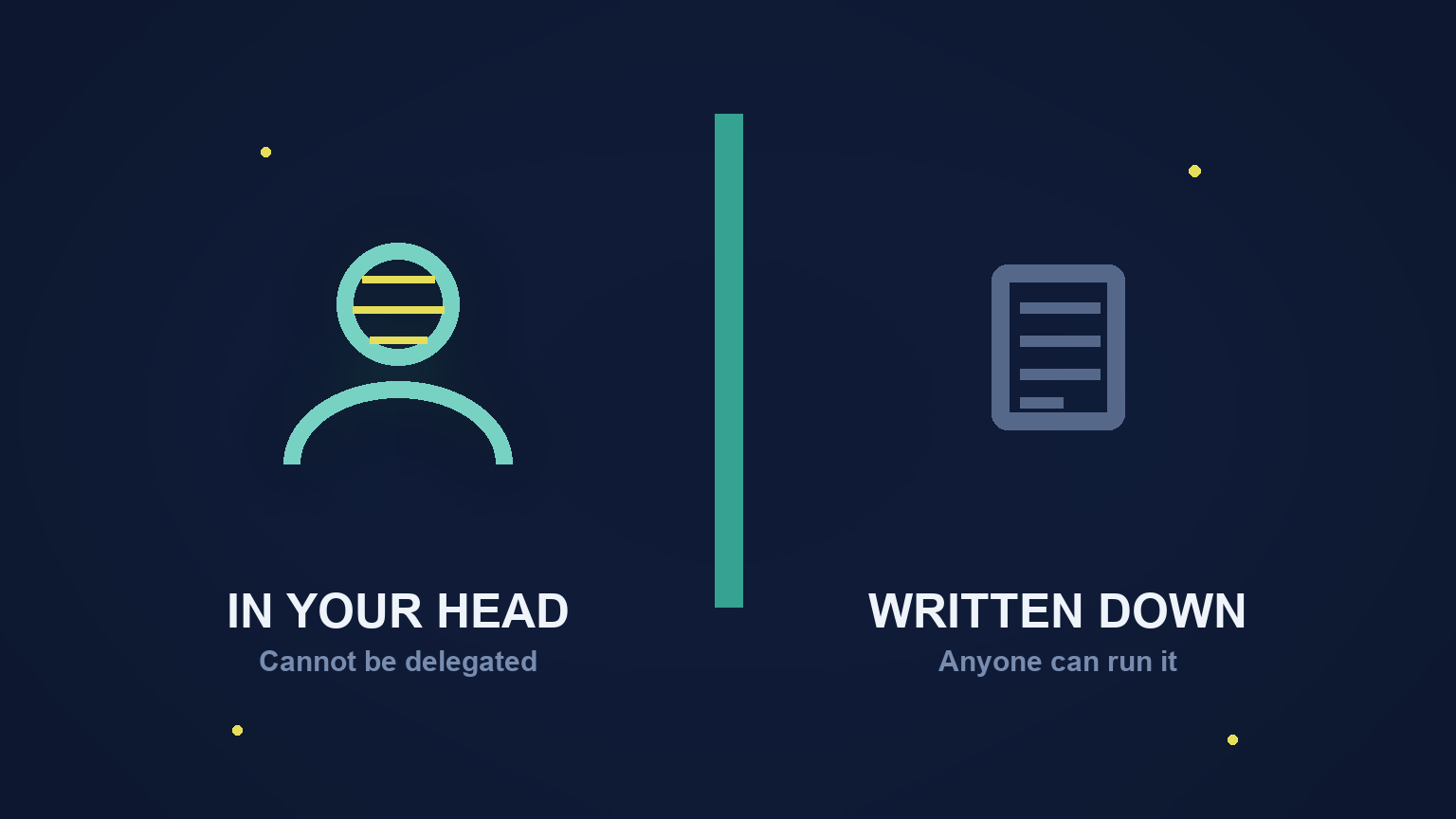
The procedure only existed in my head. I knew what good looked like. I knew the rules, the voice, the things we never do. I just had never written any of it down.
So there was nothing to hand to anyone. Not a person, not a machine.
Agencies are actually the worst at this, and I say that as someone who runs one. We're good at marketing for clients, so the work feels obvious to us. But we're so busy on client work that we never write down the obvious stuff and apply it to our own brands.
Which means it cannot be delegated. Which means it never ships unless you do it yourself.
The 3-Part Framework Every Marketing Task Needs
So here's the model that makes all of this work. Every marketing job has three parts.
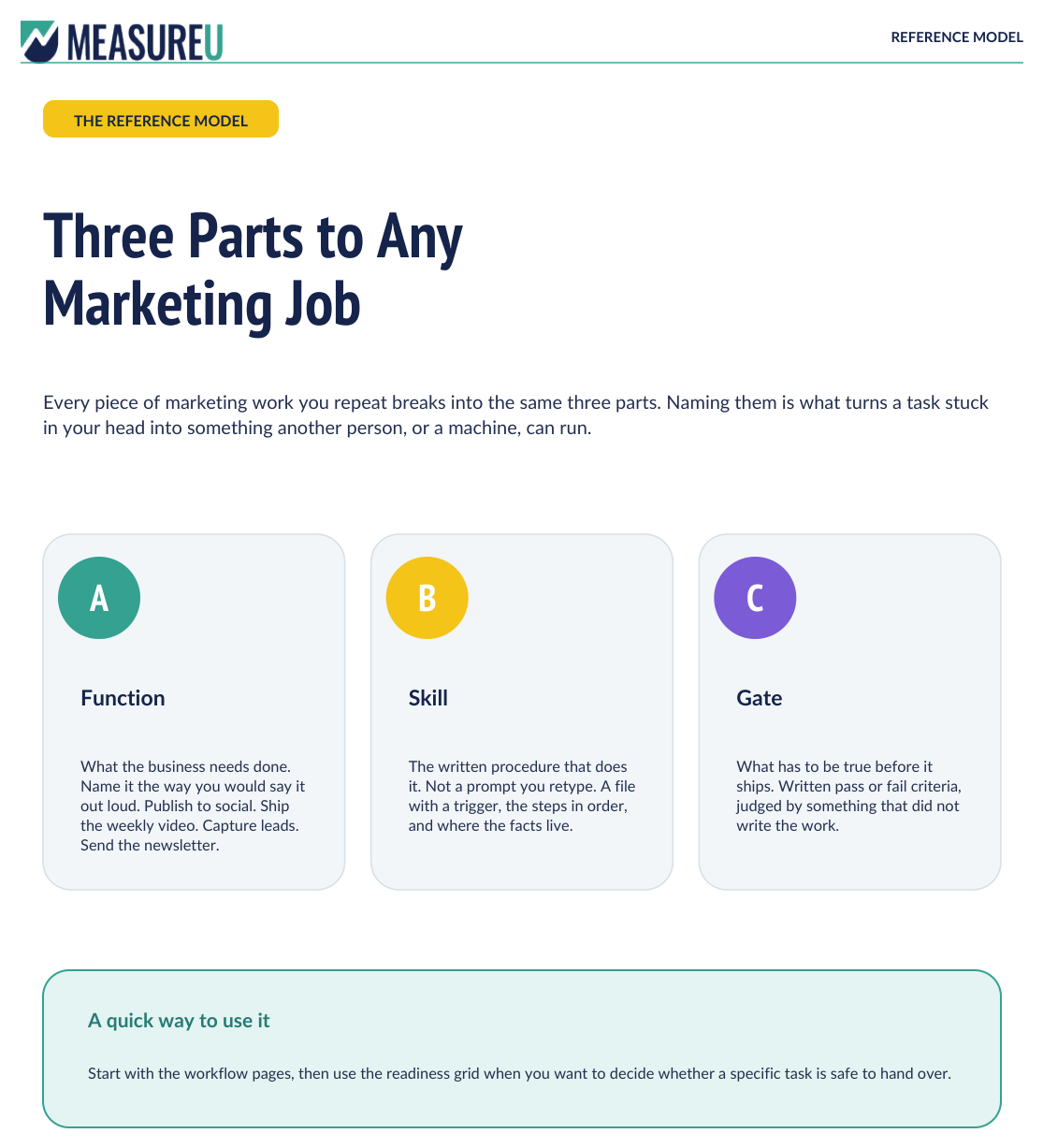
The Function is what the business needs done:
- Write a newsletter
- Publish a YouTube video
- Build a landing page
That's the Function.
The Skill is the written procedure that does the job. Not in your head. Written down, somewhere someone else can read it.
The Gate is what has to be true before the work ships. Not “it feels done.” A written pass or fail. A verdict that travels with the draft.
Most agencies have the Function. Almost none of them have a Gate. And the Gate is the only part that keeps the work honest.
Without it, you're just producing drafts that sit until someone with enough authority decides they're probably fine.
The 6 Things Your AI Needs to Do Your Marketing
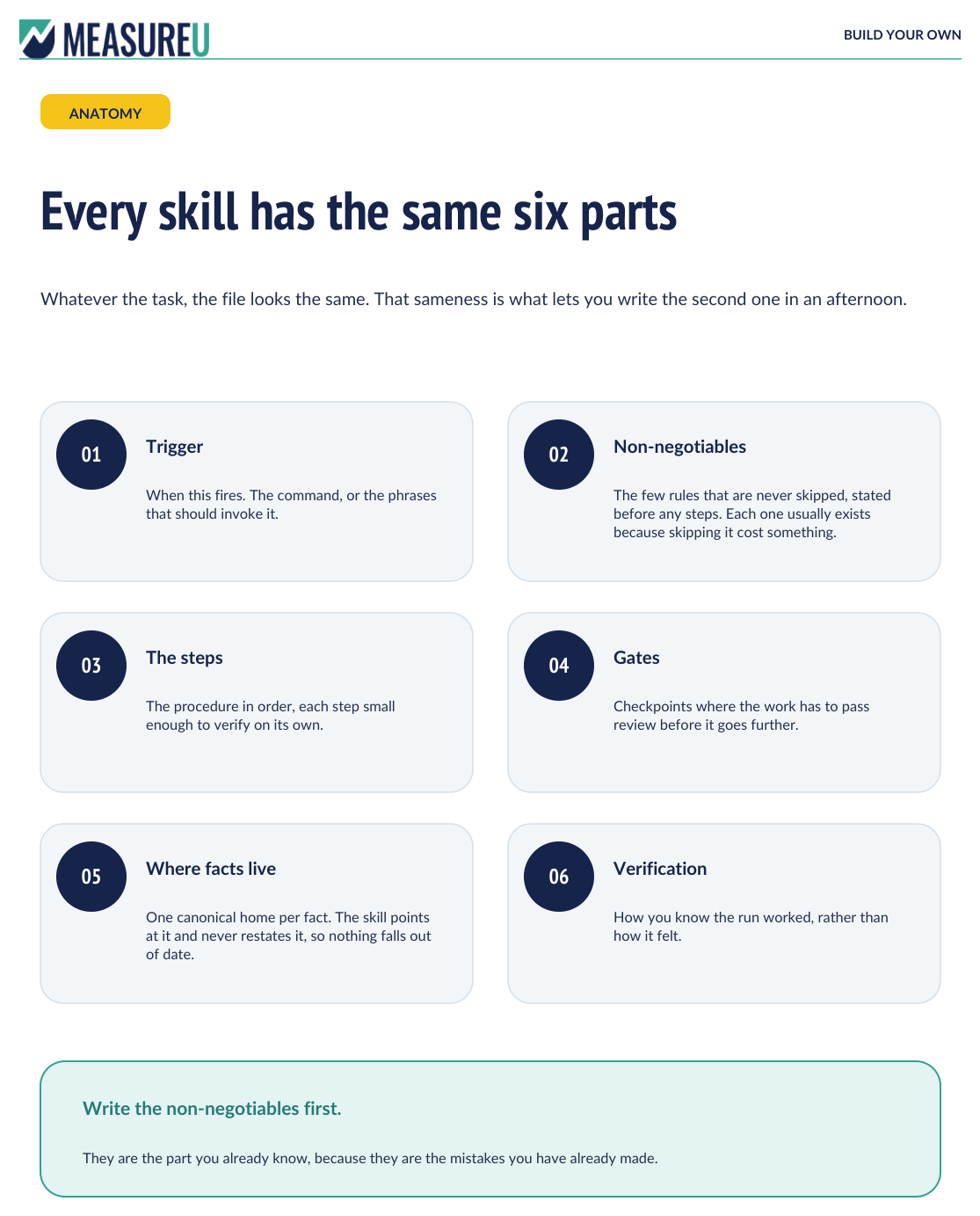
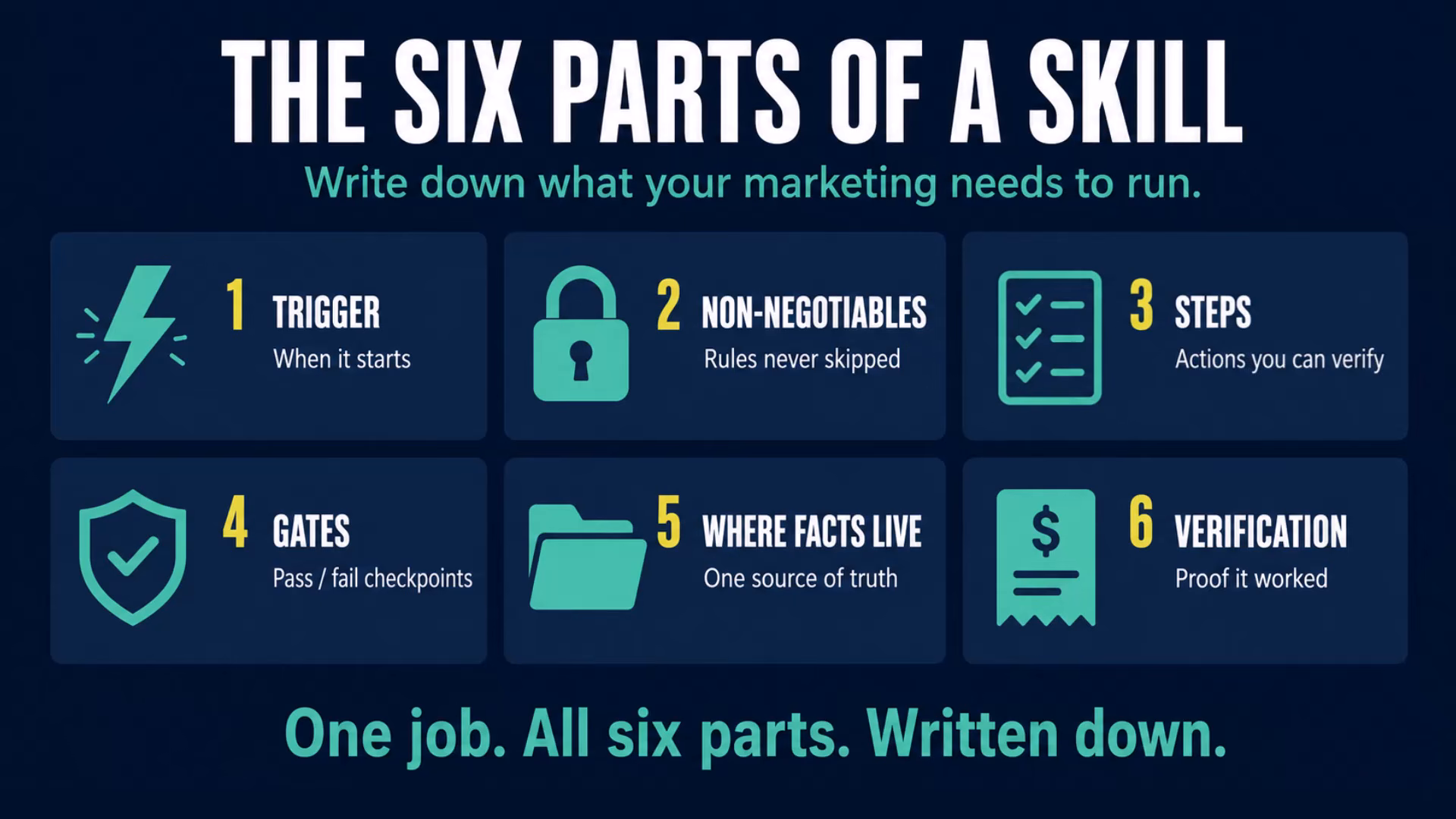
That's where the Skill comes in. A Skill has six parts, and you need all of them before AI can actually help.
1. The Trigger
The Trigger is when this fires. What command, what phrase, what situation kicks the procedure into motion.
For a newsletter, the Trigger might be: “It's Monday morning and the draft is due by noon.”
If you don't write it down, the procedure never starts at a consistent point. And you never know why some runs work and some don't.
2. The Non-Negotiables
These are the rules that are never skipped. They go at the top, before any steps.
Every non-negotiable I've written exists because AI skipped it once and it cost me something:
- A newsletter that went out without a plain-text version
- A landing page that shipped without a mobile check
Each of those is now a non-negotiable. One sentence each. Written at the top of the Skill.
3. The Steps
Each step small enough to verify on its own.
Not “write the email.” Break it down:
- Write a subject line under nine words
- Write a preview line that doesn't repeat the subject
- Write the body copy starting with the problem, not the solution
Steps someone else can follow without calling you.
4. The Gates
Gates are checkpoints inside the procedure. The work has to pass a Gate before it moves forward.
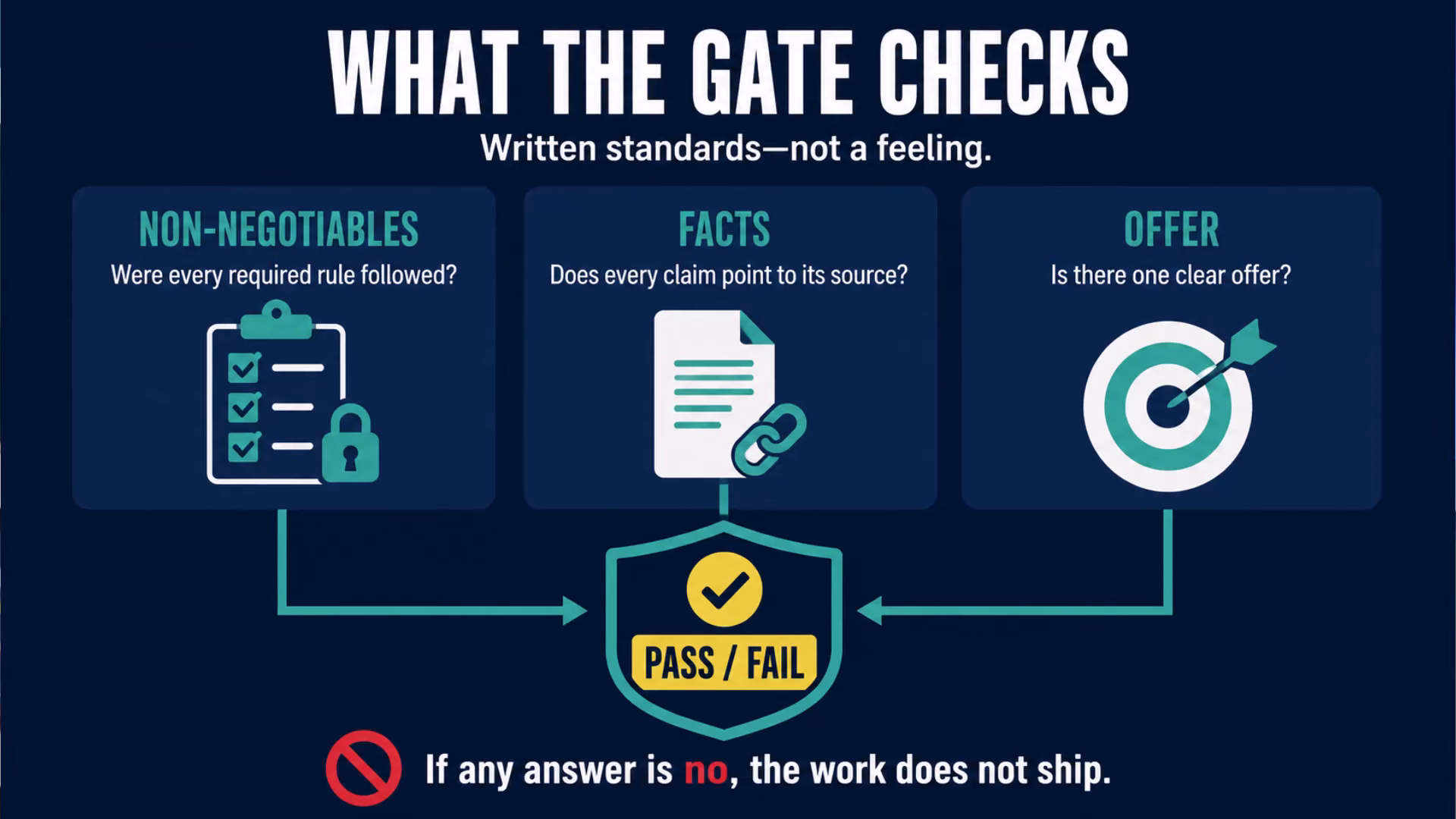
A written criterion: “Subject line is under nine words: yes or no.”
If the answer is no, the work stops there. It doesn't ship. It gets rewritten. Here's what that looks like written out for a newsletter:
| Gate check | Pass | Fail |
|---|---|---|
| Subject line length | Under nine words | Nine words or more |
| Topic count | Exactly one topic in the issue | Two or more topics |
| Link count | Two links or fewer | Three or more links |
| Closing question | Ends with a question | No question at the end |
| Read time | Under four minutes | Four minutes or longer |
5. Where Facts Live
Every piece of information your marketing uses has one canonical home. The Skill points at those locations. It doesn't restate them.
Because the moment you restate a fact inside a procedure, that copy goes out of date the next time the original changes.
One home per fact.
6. Verification
Verification is how you know the run worked. Not how it felt.
Not “the email looks good.” Instead:
| Verification check | What proves it |
|---|---|
| Delivery | The email arrived at the test address |
| Subject line | It rendered correctly in the inbox |
| Links | The tracked link registered the click |
| Unsubscribe | The unsubscribe link worked |
Why the Author Should Never Be the Judge
Here's the part that almost nobody knows about. And it's what makes your AI marketing great, or a failure.
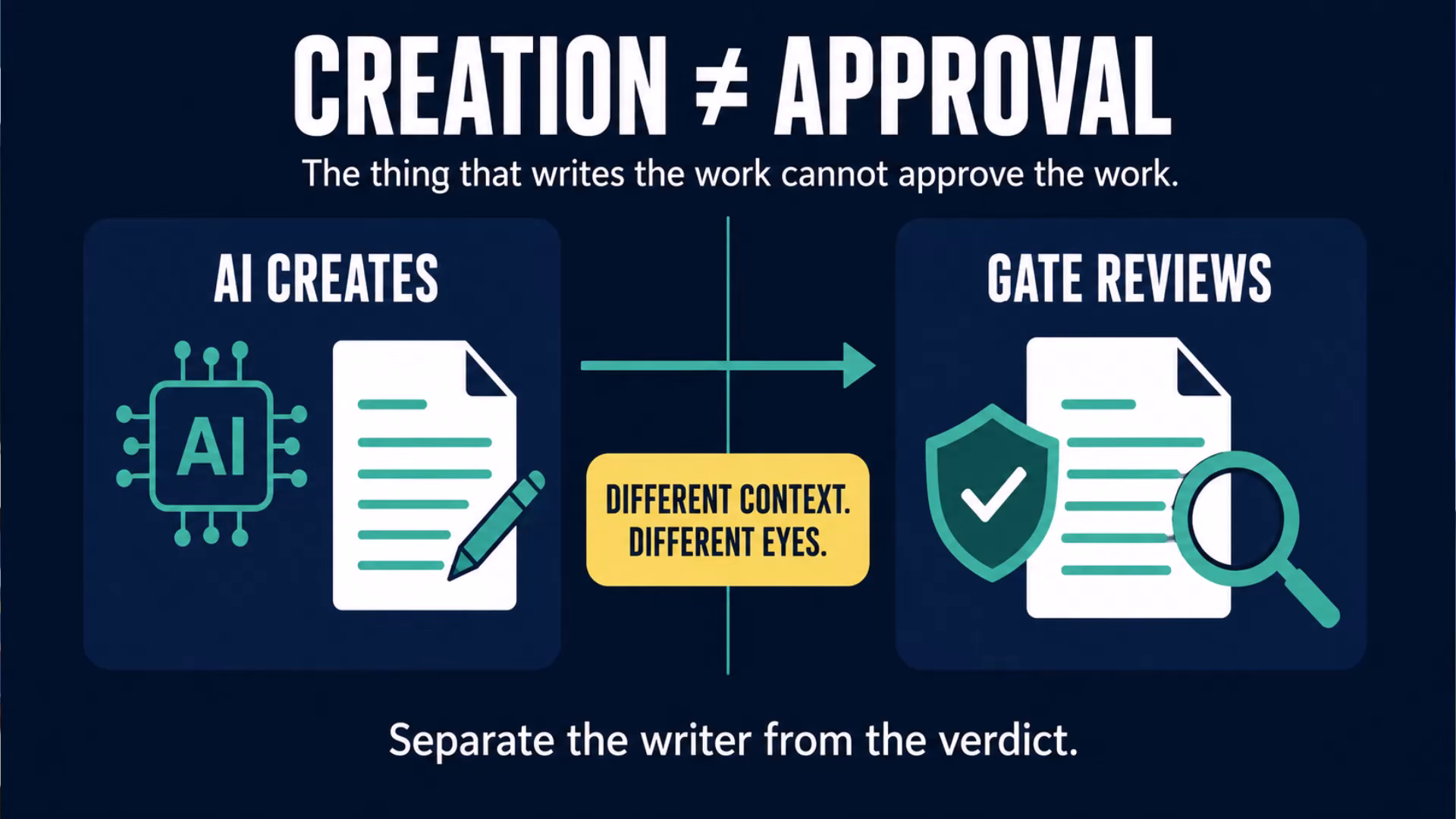
The thing that writes the work cannot approve the work.
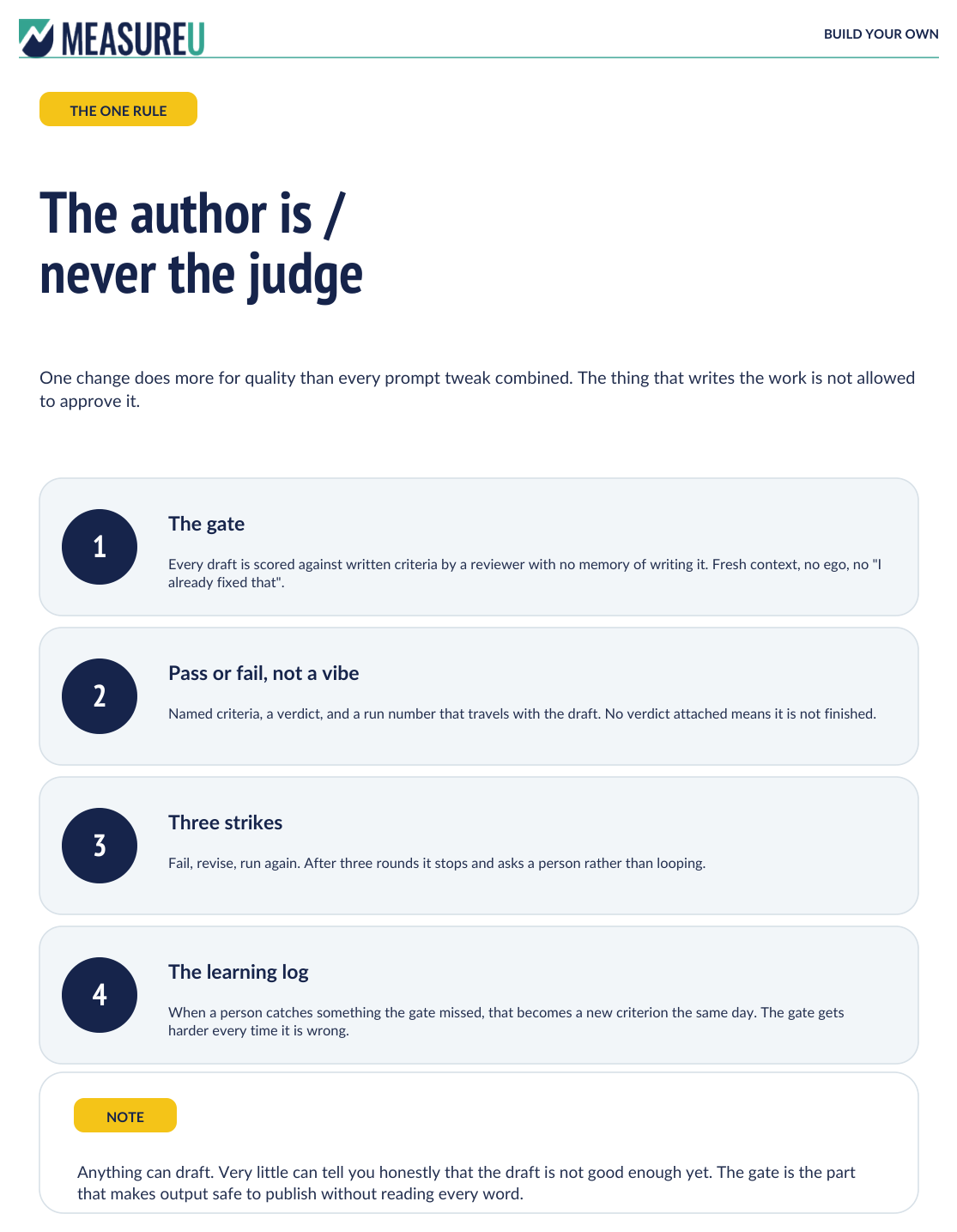
That sounds obvious. But watch how many people violate it.
You write a newsletter with AI and hit send without even reading it. Chances are it'll miss the mark. AI cannot judge its own work. It thinks everything is good.
You need a gate to review the work and make sure it meets your standards.
Traditionally, this is you, the owner, reviewing every word put out by your business. And I still recommend you review the content you put out there.
But if you add gates to your AI marketing process, you can prevent many of the most common mistakes.
A gate looks at content differently than the AI that created it. Different context, different eyes, written pass or fail criteria:
- Does it match the non-negotiables?
- Are the facts sourced to where facts live?
If the answer to any of those is no, the original AI reworks the problem.
That's what separates a system that produces work you can trust from a system that produces work you have to babysit.
How to Apply This to Newsletters, Social, YouTube, and Landing Pages
People ask me if this only works for landing pages. It works on everything. Same six components. The channel changes; the structure doesn't.
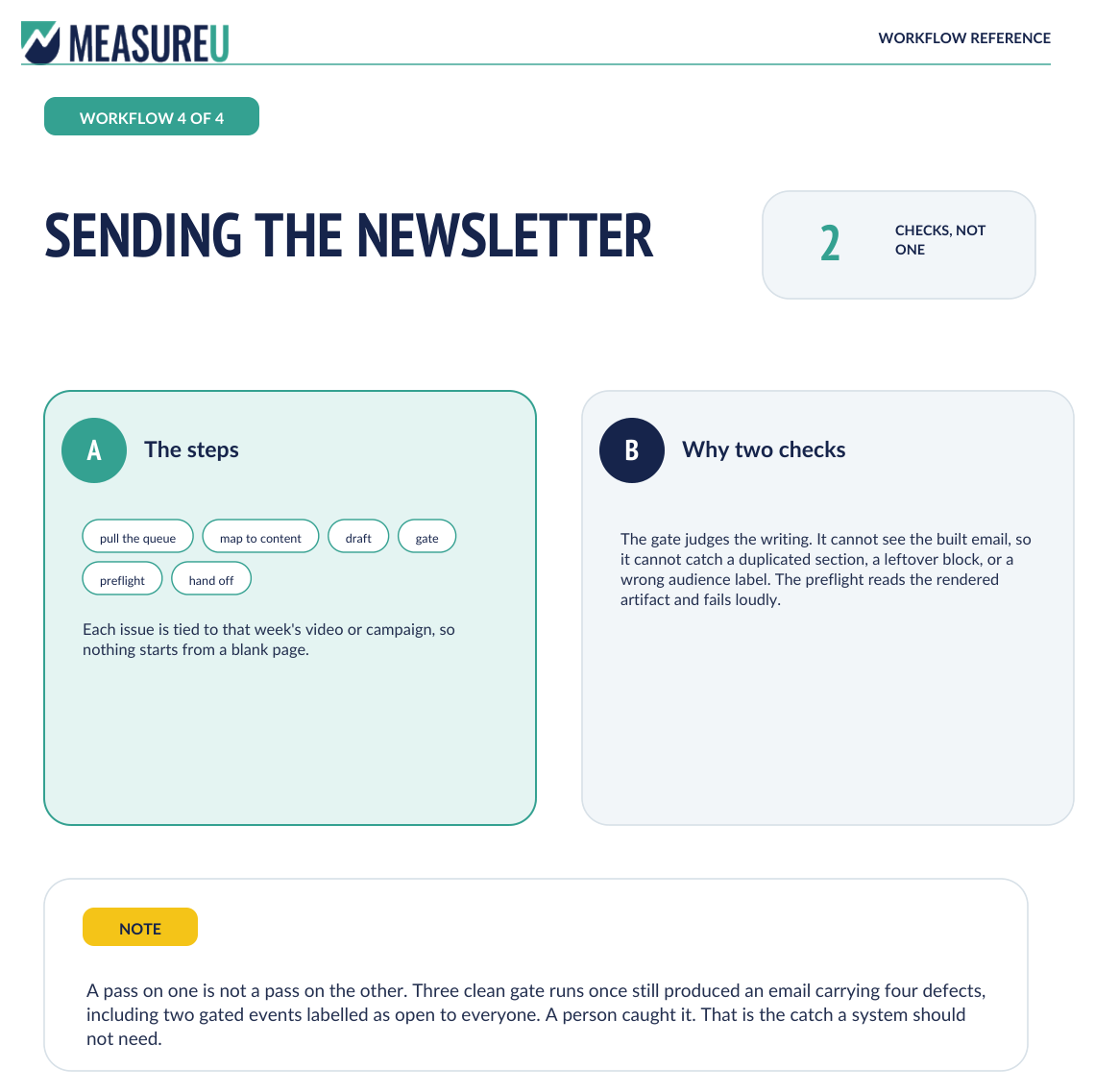
Take a newsletter:
- Trigger: a new piece of research hits the source folder
- Non-negotiables: one topic per issue, no more than two links, always end with a question
- Steps: pull the source, write the lead, write the body, write the close
- Gate: does it have one topic? Does it have a question at the end? Does it read under four minutes?
- Where facts live: the research folder, not retyped into the skill
- Verification: it shipped, the link works, the reply address is correct
Six things. That newsletter can now run without me in the room using my memory to reduce mistakes.
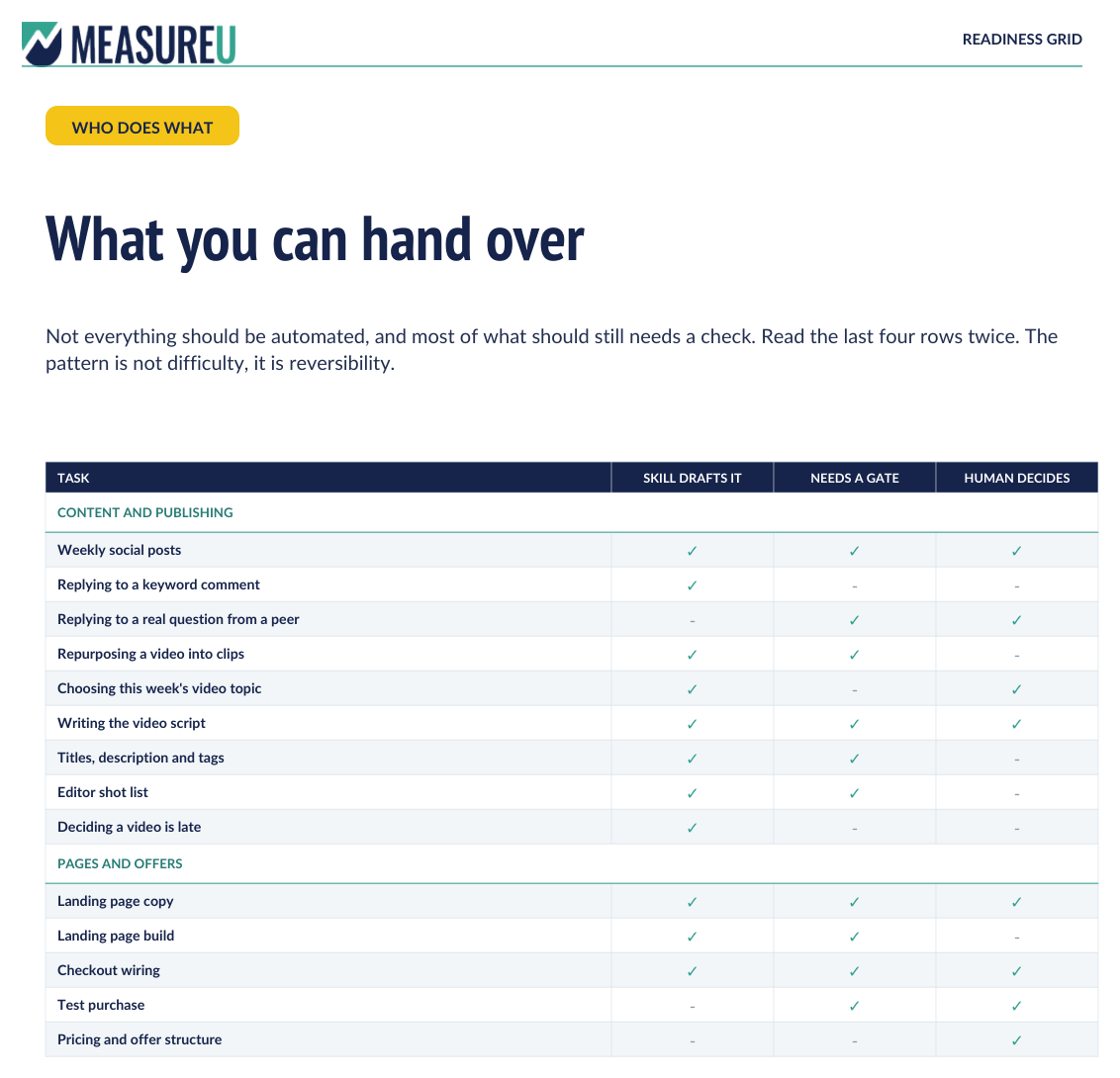
Social, YouTube, landing pages: written procedures for all of it.
That's why I stopped saying this is a marketing problem and started saying it's a documentation problem. Write the six things once. Run them on everything.
Start With the One Marketing Function You Repeat Most
So how do you get started?
Pick one marketing function that's painful for you right now. The one you personally redo most often. The one that lives in your head and nowhere else.
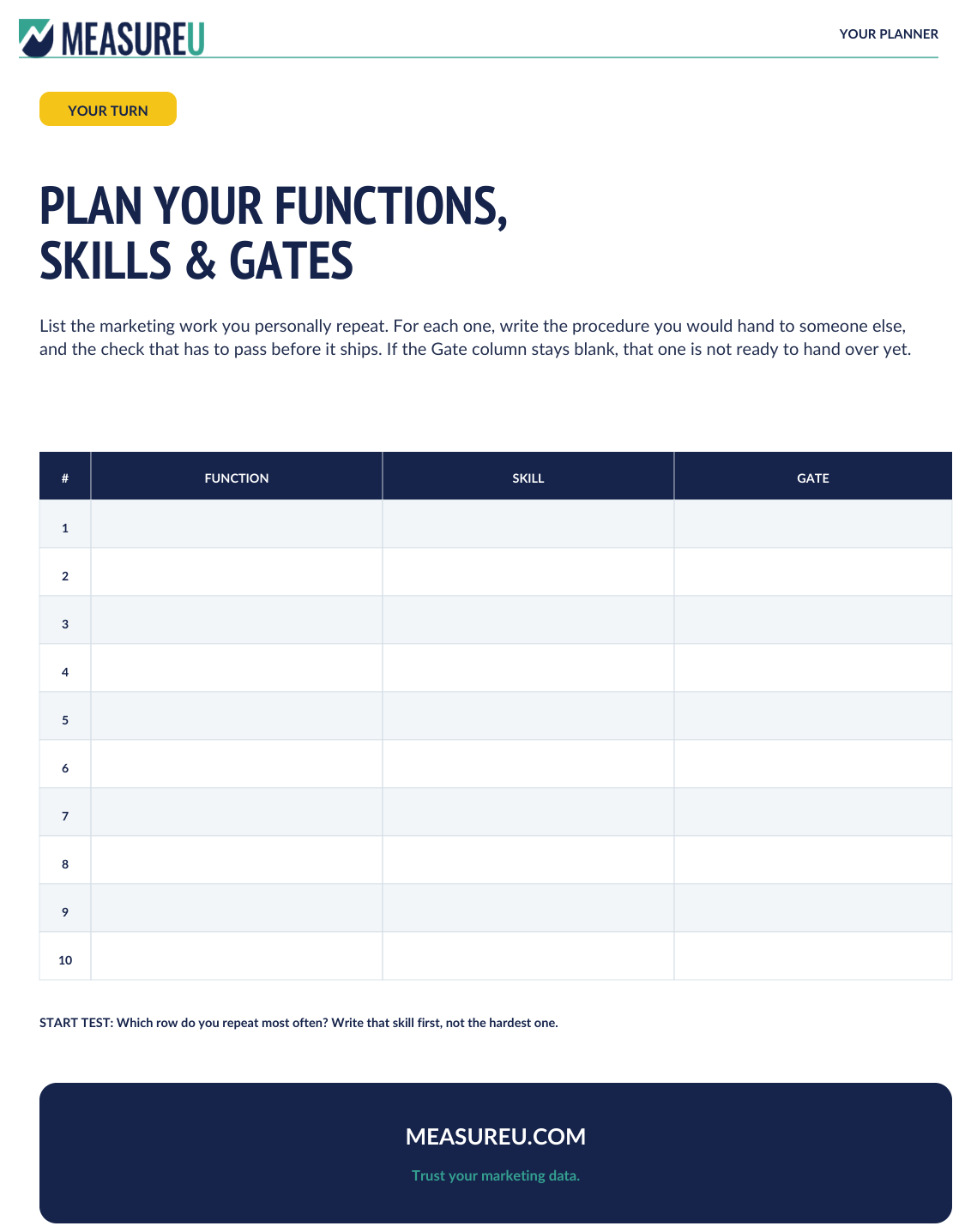
Here's what to do this week:
- Write the trigger
- Write the non-negotiables (they're the mistakes you've already made)
- Write the steps
- Write the gate
- Point to where facts live
- Write how you verify the run worked
Six things. One function. This week.
Or even better, have your AI assistant interview you to find the answers. Ask it to pull the procedure out of your head through questions. That's the same approach I used when I built an AI operating system for my own team.
If your agency is great at client marketing and invisible in its own, it's no longer a people problem. You're just not giving your AI the right inputs and gates to succeed.
I ran an agency that was great at everyone else's marketing and terrible at its own. I know exactly what that file of unsent emails looks like.
I also know what it looks like when the system runs without you.
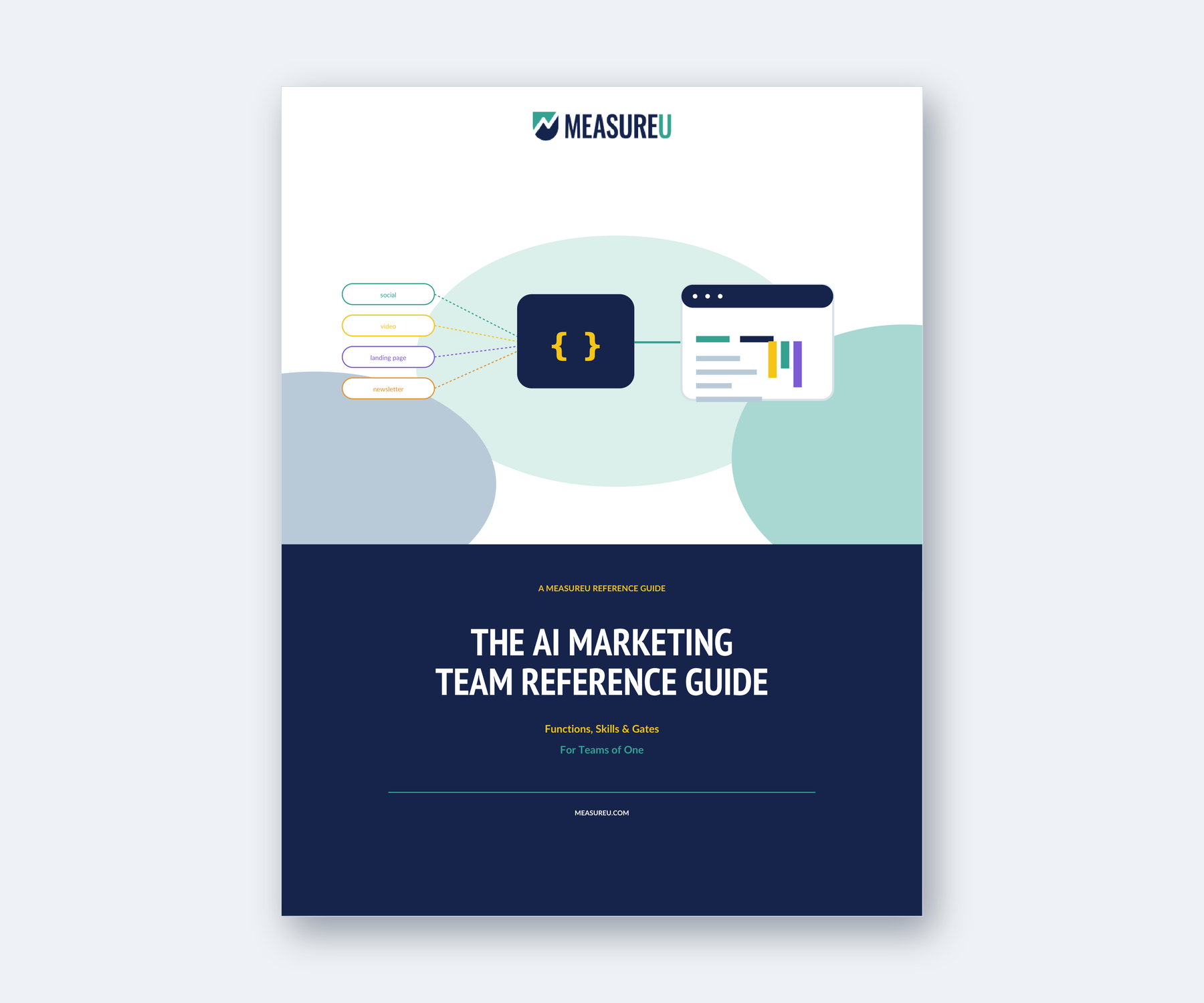
Get the Complete AI Marketing Team Reference Guide
I've produced a 16-page guide you can download and feed to your AI to make all this work for your own marketing.
It walks through exactly how to build these six components, with templates you can customize for newsletters, landing pages, social content, and more.
No cost, no call. Download the AI Marketing Team Reference Guide and start with the one function you repeat most.