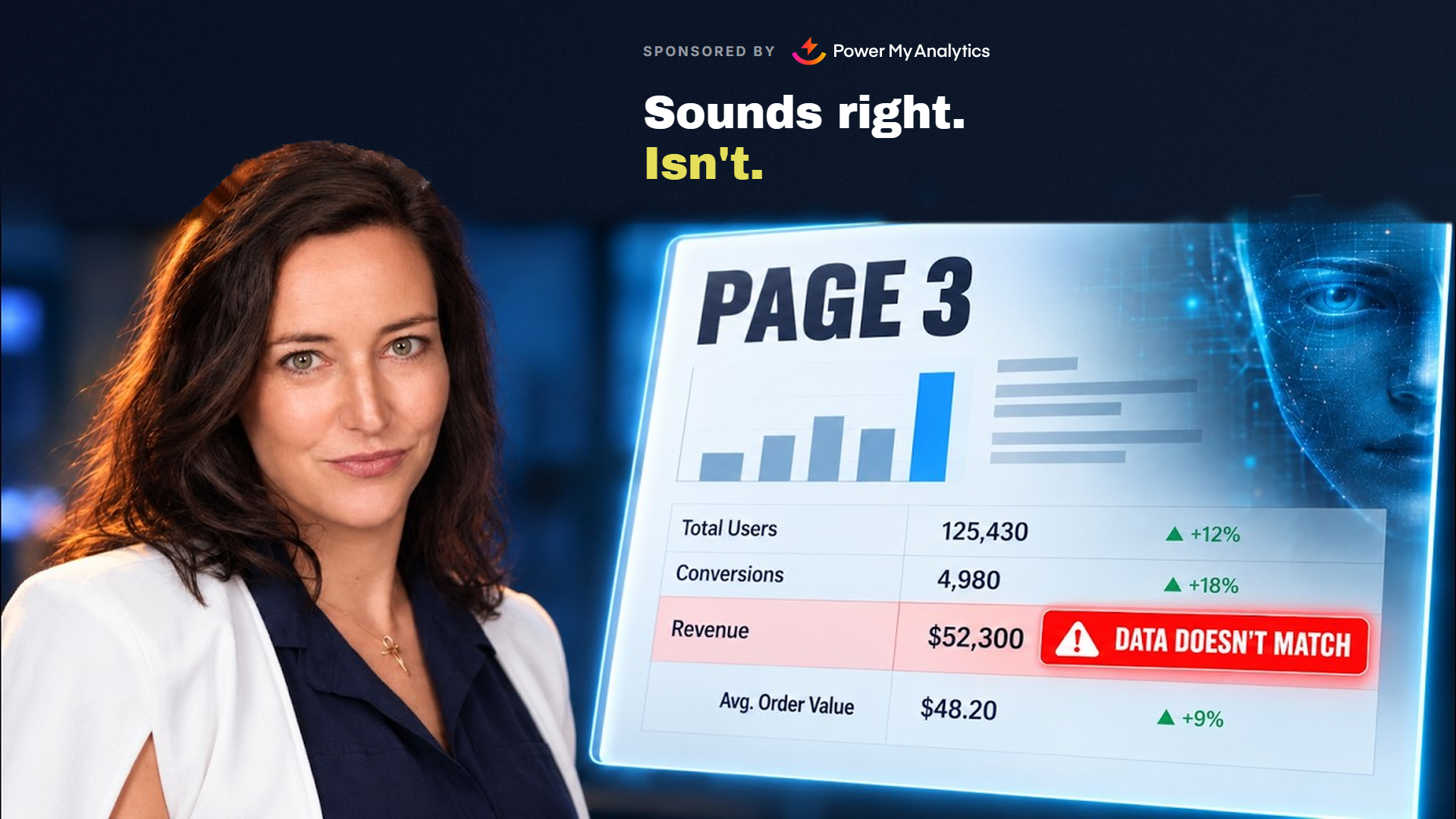
Know that feeling when you ask ChatGPT about your Google Analytics 4 data and it gives you an answer that sounds… right? The numbers seem plausible. The analysis is confident. You put it in the deck, share it with the client, maybe even make budget decisions based on it.
This post is based on a MeasureU Lunch and Learn session sponsored by Power My Analytics.
And then you realize it was completely wrong.
Here's the thing, the AI wasn't broken. You just handed it page three of six and asked it to navigate the whole trip.
Let me explain.
What You'll Learn in This Session
In this MeasureU Lunch & Learn, Antoinette “Tony” Scott, Head of Sales and Marketing at Power My Analytics, walks through why AI gives you confident answers built on scattered dashboards with zero business context behind them.
Watch the Full Session
Key Takeaways
- Your GA4 dashboard, Facebook Ads dashboard, and Google Ads dashboard are all fragments. AI treats them as equal pieces with no hierarchy or context
- AI needs three things to work properly: clean consistent data, structure and hierarchy, and business context (most teams are missing that third one)
- An “ontology layer” is just a fancy term for business context encoded into your data structure, it tells AI what your numbers mean, not just what happened
- Analysts aren't becoming obsolete; they're becoming the people who build the roads that AI drives on
Table of Contents
- The 1998 MapQuest Problem (That Lives in Your AI Today)
- Why Your GA4 and Ad Dashboards Are Just Fragments
- What AI Actually Needs: Clean Data, Hierarchy, and Business Context
- The Danger Zone: When AI Sounds Confident But Is Completely Wrong
- Why Marketing Analysts Are More Valuable Than Ever
- What Is an Ontology Layer? (The Missing Piece for AI Data Analysis)
- Real Examples: How Ontology Works in Practice
- What's Next: Building Roads for AI to Drive On
The 1998 MapQuest Problem (That Lives in Your AI Today)
Picture this. It's 1998. You're in a convertible. The roof is down. The wind is perfect. And you've got your MapQuest directions printed out, all six pages sitting on your lap.
You're ready.
And then the unthinkable happens. Pages one, two, four, five, and six? Gone. Just gone. Flying somewhere behind you on the highway.

But you have page three.
You're somewhere in the middle of the directions. You don't know how you got there. You don't know how it ends. You just know you're on a road, you can see the name of the exit you just passed, and you need to get to Highway 70.
So what do you do? Pull over? Turn around? Hope the next exit makes sense?
You probably panic. But you keep driving. Because what else are you going to do?
Fast forward to today. We have GPS. Real-time traffic. Cars that practically drive themselves, turn by turn, recalculating, always knowing exactly where you are and what's coming next.
We solved the MapQuest problem.
But here's what nobody's talking about: we took that same problem, scattered, incomplete, unstructured information, and migrated it directly into AI.
Why Your GA4 and Ad Dashboards Are Just Fragments
So what does page three of your MapQuest directions actually look like in 2026?
It's your Facebook Ads dashboard. It's your Google Ads dashboard. It's your GA4 analytics dashboard.

Each one telling you something. Each one showing real information. But none of them shows you how you got here, and none of them shows you where all this is going.
You have fragments of the middle. No origin. No destination. Just metrics.
Same chaos, new technology.
That's what I tell people when they're hesitant about adapting AI technology. We've been here before, many times, and we'll solve this the same way we always have. By building the missing infrastructure.
What AI Actually Needs: Clean Data, Hierarchy, and Business Context
There's a belief spreading through marketing teams right now that goes something like this: “The data is all there. AI can do the rest.”
I hear this constantly. And I understand why it feels true. These tools are genuinely impressive. You ask a question, you get an answer. It sounds smart, confident, complete.
But here's what's actually happening under the hood.
AI works a lot like a data lake. And if you've ever worked with a data lake that nobody manages, you know exactly where this is going.
A data lake without governance is just a data swamp. Everything goes in. Nothing gets labeled. There's no hierarchy. You pull something out and you're not even sure where it came from or what it is.
AI pulls data the same way. There's no hierarchy. It doesn't know that your revenue metric in Google Ads means something completely different from your revenue metric in Meta Ads. It doesn't know that your campaign called “summer brand video 2024” is the same campaign as “summer 24 brand video” in your CRM.
It treats everything as equal. Every metric is agnostic. Every data point carries the same weight regardless of what it actually means to your business.
So when you ask AI which campaign drove the most efficient revenue last month, it answers you confidently with a number.
And the number might be completely wrong.
Not because AI is broken, because you handed it page three and asked it to navigate the whole trip.
The Three Things AI Actually Needs
1. Clean, consistent data. Same metric names across all platforms. Standardized campaign naming. Attribution windows that are actually documented somewhere outside of your analyst's brain.
If your data looks different in every system, AI is going to stitch together something that looks coherent but isn't. It's going to hand you back all six pages of directions, but it made up the ones it didn't have.
2. Structure and hierarchy. Not everything is equal. Your primary conversion metric matters more than your impression count. Your top-of-funnel campaigns should be evaluated differently than your bottom-of-funnel campaigns.
AI needs those relationships built in before it starts making connections. Otherwise, it's treating your page three exit ramp the same as your final destination.
3. Business context. What is good for your brand? What are your benchmarks? Who is your audience and why do they behave the way they do?
This is the layer most people haven't built yet. And it's the one that makes AI go from calculator to strategic partner.
Without all three, you're handing AI page three of your MapQuest directions and asking it to plan the full route. It will give you something. It just might not get you where you're going.
The Danger Zone: When AI Sounds Confident But Is Completely Wrong
So where's the actual danger zone?
The danger zone is the gap between what we think AI knows about our data and what it actually knows. And that gap is way wider than most teams realize.

Because AI sounds confident. That's the problem.
It wants to please you. It wants to give you an answer. It's not going to say “I don't know, try again.” It doesn't say “I'm not sure, I'm missing the first five pages.”
It says “your top performing campaign last month was X”, in full sentences with supporting detail, like it did the analysis.
And people trust it. They put it in the deck. They share it with clients. They make budget decisions based on it.
The danger zone is trusting the output without validating the foundation.
When AI Chases the Wrong Goal
Morgan Jones, CEO of Power My Analytics, shared a perfect example of this during our Q&A.
He was running a pricing change analysis on a product for one of his businesses. AI came back and said: “Yeah, that price might be a little too high because you actually had less sales when you raised prices. Less units were sold as a result of raising prices.”
Sounds reasonable, right?
But Morgan had to retrain the AI: “That's not the goal. The goal isn't unit sales, it's profit. Here's my cost of goods sold for this item.”
Once AI had that context, it reevaluated and said: “Oh wait. As you increased pricing, your profit actually increased even though your units sold went down.”
The outcome? AI actually recommended exploring continuing to raise prices to see where profitability starts falling off.
Same data. Completely different (and correct) conclusion. The only difference was business context.
Why Marketing Analysts Are More Valuable Than Ever
Here's the part I really love about all this.
Your job still exists.

I know you've been reading the headlines. AI is coming for everyone's job. Analysts are obsolete. Data teams are dinosaurs.
No.
The people who understand data structure, data hierarchy, data context, those people are more valuable right now than ever. Because someone has to build the foundation that makes AI actually work.
AI can drive the car. But someone still has to build the road.
The GPS only works because someone mapped every road, every turn, every speed limit, every exit ramp. That work didn't go away when GPS was invented. It became the entire reason GPS continues to work.
Same thing is happening right now with marketing data and AI. The analysts who know how to structure data, create hierarchy, and encode business context? They're the people building the roads that AI drives on.
So instead of asking “will AI replace me?” start asking “how do I build the infrastructure AI needs to be useful?”
That's a much better question. And the answer is a career path, not a dead end.
What Is an Ontology Layer? (The Missing Piece for AI Data Analysis)
That's where the ontology layer comes in.
Big word. But it's just a fancy way of saying: business context encoded into your data structure.
So when AI looks at your numbers, it doesn't just see numbers. It sees what those numbers mean relative to your business, your benchmarks, your history, your plan.
Raw data tells AI what happened. An ontology layer tells AI what it means.
That's the jump from AI as a calculator to AI as a strategic partner.
Three Ontology Examples That Make This Real
Power My Analytics is building this layer right now. Here's what the first three implementations look like:
1. Brand Name Mapping
If you're a marketing agency, you're probably connected to your clients through your email address. When you bring them into your reporting tool, the system doesn't know the difference between which accounts are yours, which are theirs, which belong to ABC Company versus XYZ Company.
So you talk to Claude and it says: “Your ads are doing great! Looks like you're running 16 different Facebook accounts.”
But that's not true. Those aren't all yours.
Brand name mapping solves this. You go in, look at each account, and add the brand name associated with that account. Now AI has the context to know which data belongs to which client.
2. Budget Pacing Alerts
This is a big one, and Power My Analytics gets asked about it constantly: “How can I connect this to how I'm pacing according to my marketing budget?”
This ontology layer gives AI a timeline. You can use ranges like this week, this quarter, last quarter, and see how you're performing with your marketing spend according to the budget you've been allocated for each channel.
You can do manual entries. You can organize it however makes sense for your business. And now AI can tell you when you're over pace, under pace, or right on target, because it has the context of what the budget actually is.
3. Campaign Goal Context
Not all campaigns are created equal. And this is where things get dangerous without context.
AI might look at a campaign and say: “Wow, your conversions are really low. You should stop this ad.”
But maybe you didn't create this campaign for conversions. Maybe you created it for brand awareness. And it's actually performing really well against that goal.
Campaign goal context lets you tag each campaign with its actual objective. Now AI knows to evaluate your awareness campaign on impressions, your consideration campaign on engagement, and your conversion campaign on… well, conversions.
GA4 Analytics and Custom Dimensions
During the Q&A, someone asked how this applies to GA4 specifically, especially for e-commerce tracking with custom dimensions and events.
Here's the reality: GA4 has some ability to create ontology through custom dimensions. But if you don't set it up correctly in GA4 (or if the history of it being set correctly isn't there), you can do it after the fact.
Morgan gave a great example: a client needed to categorize all their European GA accounts as “Europe” for aggregated reporting. You can't really do that across accounts in GA4 itself, at least not easily.
So they created a custom ontology dimension outside GA4. If any of the GA accounts are in the EU, this is “European.” If it's in Canada, it's “Canada.” If it's US, it's “US.”
Now you can ask the MCP: “What is my total traffic and revenue for the EU?” And it sums up across all those multiple GA4 accounts and gives you a number.
That's data-driven marketing that actually makes sense, because the business context is built in.
Real Examples: How Ontology Works in Practice
Let me give you some more concrete examples of how this plays out.
The Skid Steer vs. Skid Mark Problem
Tony shared a story from a previous job in tool rental. The amount of people who would type “skid mark” instead of “skid steer” was… pretty remarkable.
And this is the reality of CRM data. Manual entry is messy. People fat-finger things. They misspell. They forget the correct labels altogether.
The solution? Create a separate data set, essentially an ontology layer, where you have common misspellings in one column and what they should actually be in a second column.
You're creating a SQL data set with a column that the main table can join on. One table understands the correct spelling, the other column has all the gibberish that comes in, all attributed to that same correct term.
You won't catch everything. That's just the nature of manual entry. But you can catch a lot of it. And you can even use AI to help: “Hey, read all my recent entries. Are there any that might look like ‘skid steer' but are actually something different?”
The Promotion Link Tracking Example
Here's another one. Power My Analytics ran a promotion recently: if you switch from a competitor, they'll give you a trial for the remainder of your contract.
They wanted to see how many people clicked on that link. But there were four links in the email, all going to slightly different places.
Without an ontology layer, you go into GA4 and ask “how many people clicked on that link?” and GA4 basically says: “I don't know, there are quite a few links in there that maybe could be that link?”
With an ontology layer, you give all those links an extra attribute, all named the same thing, so they're unified under one promotion name. Now when you ask Claude, it doesn't have to guess. It knows exactly what “competitor switch promotion” means.
The Automated Price Testing Future
And here's where this gets really interesting. Morgan talked about wanting to automate price testing.
The vision: tell Shopify to adjust pricing on a product over the next couple weeks. Raise it a bit, lower it a bit, try different price points. Come back with the numbers and tell me what the optimal price is for my business.
But if AI assumes (or just decides on its own) that unit sales is the objective, it might tell you the lowest price is best. Which sounds logical, more units, more sales, right?
Except that's not going to put cash in the bank account.
By giving AI a clear objective through the ontology layer, profit growth, here's the cost of goods sold, here are any other factors, then it can automate itself, give you a feedback loop, and eventually optimize on its own.
Without that context? It optimizes for the wrong thing. And you might not even realize it.
What's Next: Building Roads for AI to Drive On
The next evolution of these tools, and similar products, is write access to campaigns. AI saying: “Hey, this campaign's not getting the impressions you need. Should we pause it? Should we switch to a different creative?”
And if AI doesn't have the context of what the goal was in the first place, it's going to give you the wrong advice about what to do next.

That's a much riskier decision than just getting a bad report. That's AI making changes to your actual campaigns based on incomplete information.
Which is exactly why building this foundation now matters so much.
We're not there yet. But we're building the road.
And unlike that convertible on the highway in 1998, this time we're keeping all six pages inside the car.
Destination: success.
Ready to make your data AI-ready? The first step is understanding what context your AI is missing. Look at your current dashboards and ask: Does AI know my campaign goals? My attribution model? Which accounts belong to which brands?
If not, you're handing it page three and asking it to navigate the whole trip.
I'd love to hear what context gaps you're finding in your own data.
If you want the training that turns this into a working process on your own data, check out MeasureU Pro.