Tired of watching your agency profits swing wildly while your headcount stays steady? You're not alone.
Anna Lewis knows that feeling intimately. She's the founder of Polka Dot Data, and after 10 years running her analytics consultancy, she's made pretty much every data analytics hiring mistake you can make. Including the big one, hiring 8 people when the work couldn't support it.
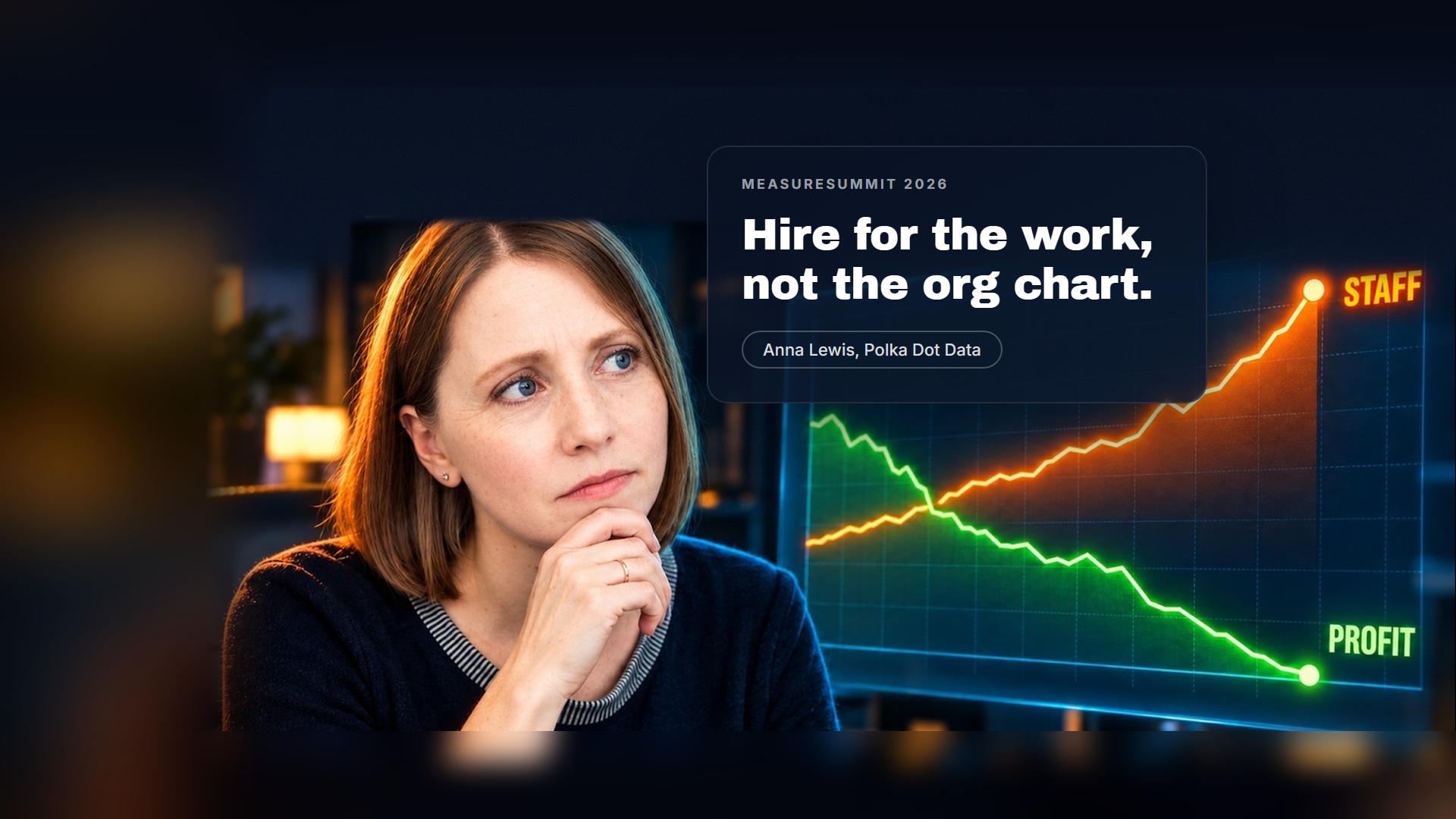
Her own chart tells the story: headcount running high while revenue and profit bounced around like a pinball. Some years the lines were so close together there was barely any profit at all.

But here's what changed. She figured out which mistakes were killing her margins, and which metrics to track so she'd see problems coming before they crushed the business.
That's where this checklist comes in. Whether you run an agency or lead an in-house analytics team, these are the 6 hiring mistakes to avoid and the numbers to watch.
Watch Anna's Full MeasureSummit Session
In this MeasureSummit 2026 talk, Anna walks through everything from DISC personality profiles to the exact ratios she reviews monthly.
What You'll Learn in This Post
- Your dream org chart is probably your ego talking, hire for what the work actually needs
- The DISC profile can reveal dangerous “clone hiring” before it tanks your team's problem-solving ability
- Track your staff-profit ratio monthly (revenue per person ÷ salary) or you're flying blind
- “Hire slowly, fire quickly” sounds harsh but Anna admits she's had to end contracts nearly every year
Table of Contents
- Mistake 1: Hiring the CV, Not the Environment
- Mistake 2: Cloning Your Team
- Mistake 3: Ignoring Your Context
- Mistake 4: Building the Wrong Structure
- Mistake 5: Treating the Job Spec as Static
- Mistake 6: Not Tracking Team Profitability
- The Analytics Team Checklist
Mistake 1: Hiring the CV, Not the Environment
Anna used a beautiful analogy here: imagine you find the most gorgeous rose. Perfect CV. Exactly the credentials you wanted.
But if your team environment is wrong for that rose? It won't thrive. And neither will your margins.

The things that actually matter often aren't on the CV at all:
- Curiosity and adaptability: How quickly can they switch between tasks or projects? In Anna's interview process, she asks candidates about times they didn't know how to do something. Some people just Googled it. Others rebuilt their entire approach. The difference matters.
- Communication skills: We're full of brilliant analytical minds in this industry. But can they get that brilliance out and explain it to clients or stakeholders?
- Non-negotiable values alignment: Is your team all about supporting each other? Or competitively driven for fast results? Neither is wrong, but hiring someone who doesn't match will create friction.
- Resilience over academics: And this one might sting a bit.
Here's what Anna said directly: “Resilience probably matters more than academics. You can have all the academics in the world, but unless you've got the resilience to keep working at it in the real world, it's not going to count for anything.”
So in your hiring process, dig into what candidates have actually done with their learning. What challenges did they overcome? How did they push through? Because a beautiful CV means nothing if they crumble at the first difficult client.
Mistake 2: Cloning Your Team (The Sunflower Field Problem)
Picture a field of sunflowers. Beautiful, right? But they're all thinking the same way, questioning things the same way, coming up with the same solutions.
That's what happens when you hire clones of yourself or your existing team.

Anna's recommendation: run a DISC profile on your entire team before your next hire. DISC breaks people into four overlapping areas:
- D (Dominant): Assertive, results-driven, sometimes too much (Anna admits this is her)
- I (Influencer): Can change minds, bring energy
- S (Steady): Reliable, supportive team players who bring people together
- C (Conscientious): Analytical, process-driven, great at finishing projects
When Anna mapped her team, each person showed up as a star on different parts of the profile. She's in the red dominant zone. Her analytics developer sits in the blue conscientious zone, questioning things, following systems, actually finishing projects.
The insight? When you're hiring, check where your gaps are. If everyone on your team clusters in the same quadrant, you've got a problem. You'll all approach challenges identically and miss solutions that someone with a different brain type would catch immediately.
Mistake 3: Ignoring Your Context (Agency vs. In-House)
Anna used another gardening analogy here, a flower bed with vegetables and a gap to fill. Do you put in a tree? A rose bush? Neither fits.
The same logic applies to data analytics hiring for agency versus in-house roles.

If you're hiring for an agency:
- They need to switch between tasks and clients constantly
- Account management and client communication are critical
- Deep institutional knowledge isn't possible, they won't live inside one business
- Flexibility and context-switching ability matter more than specialization
If you're hiring in-house:
- They can go into deeper context on your specific data
- They need to manage up and across the business
- Internal politics navigation becomes a real skill
- Fighting for resources is part of the job
So think about what day-to-day skills your environment actually requires. A brilliant agency consultant might struggle in-house. A fantastic in-house analyst might hate the chaos of agency life. Neither is wrong, they're just different environments.
Mistake 4: Building the Wrong Structure (Or Too Big, Too Fast)
This is the mistake Anna made with 8 people.
She hired too many for the amount of work available. And that chart she showed, with headcount high while profit and revenue swung dramatically, that was the result.

Sustainable growth doesn't come from building your dream hierarchy. It comes from matching your structure to your actual work.
Here's how Anna breaks down team sizes:
- Small team (1-3 people): Everyone wears every hat. You need generalists who can handle strategy, execution, and client communication.
- Mid-size team (4-7 people): Now you can have specialists. But they need to communicate really well with each other.
- Larger teams (8+): Silos will happen. People become insulated from each other. Your job shifts to watching for that insulation and improving communication channels.
The ego trap? Designing a beautiful hierarchy in your head, Head of Analytics, BI Developer, Data Governance Lead, Client Success Manager, before you have the revenue to support it.
Don't hang on by a thread. And don't build so big you have to make redundancies or go out of business.
Mistake 5: Treating the Job Spec as Static
The job description you wrote 18 months ago? It's probably wrong now.
Anna keeps job specifications inside her one-on-one documents with each team member. Every regular catchup, she asks: “Here's your job spec. Is there anything we need to change?”

Things that should trigger a job spec review:
- AI has changed the work: Have certain tasks been replaced by AI? Does “AI management” need to be part of this role now?
- The business has shifted: What you needed when you hired them might not be what you need now
- The person has developed: They may have grown past the original role, or grown in a different direction
And here's an exercise Anna recommends: write out the complete customer journey for your business, then list every task that happens at each stage. Map who currently handles each task.
What you'll discover is revealing, maybe you've got loads of work for one type of role but almost nothing for another. The gaps become obvious. And those gaps basically write your next job spec for you.
Mistake 6: Not Tracking Team Profitability
This is where most agencies fly completely blind.
Anna learned this one from Fred Pike (who interviewed her for this session). He reviews these numbers monthly in his business stats pack, and she does too now.

The Numbers to Track
Staff-Profit Ratio
Total revenue earned per person ÷ their salary = a ratio showing how much revenue each person generates.
This is eye-opening when you actually calculate it. Some team members might have drastically different ratios than others. Understanding why helps you make smarter decisions.
Salary Percentage of Turnover
Total staff costs ÷ revenue = a percentage you can watch over time.
Anna's been anywhere from 20% to 60-70%. There are definitely percentages she's happier with. When it creeps up too high, she knows she either needs to rein in costs or increase revenue.
Revenue Per Person
Simple division, incredibly helpful. Keeps you honest about whether each person is actually contributing to profitability.
Morale Feedback
This one isn't always a number, though there are apps that can collect weekly ratings from your team. But Anna puts it bluntly: watch for dementors.
For those who don't get the Harry Potter reference, a dementor is someone who sucks the positivity and happiness out of everything. If you've got one in the business, it's detrimental to everyone. Address it immediately.
The Hardest Truth
Anna said something in this talk that stuck with me: “I've had to end contracts or probation periods nearly every year. And those words, ‘get rid of somebody', aren't nice. But it feels like I've had to do it nearly every year.”
The longer you leave a bad fit, the more expensive it gets. Other beneficial team members may leave. Everyone's mood suffers.
“Hire slowly, fire quickly. Unfortunately, it really does need to be that way around.”
The Analytics Team Checklist
Here's Anna's summary of everything, the checklist she wishes she'd had 10 years ago:
- Hire for mindset first: Skills can be learned. Character can't necessarily be changed.
- Know your skill and brain-type gaps: Run the DISC profile. Find where you're missing coverage before you hire another clone.
- Values must be aligned: This is non-negotiable. Misaligned values poison teams slowly.
- Structure should serve the work: Not the hierarchy in your head. Not your ego.
- Outsourcing is a legitimate strategy: Full-time isn't always the answer. Contractors, freelancers, agencies, and offshore teams all have their place.
- Diversity across personalities matters as much as skills diversity: Different brains, different approaches, better solutions.
- Treat AI like a junior team member: Mentor it. Keep an eye on it. Give it menial tasks. Use it to speed everyone else up.
- The dream team isn't static: Keep reviewing where you are, where the gaps are, what needs to change.
And one more that came up at the end: trust.

“If you've lost trust at any point, that's something you really need to address. And if it's gone, it's gone, and that might not work out anymore.”
Your Next Step
Before your next data analytics hire, run through this checklist. Seriously, print it out or save it somewhere you'll actually see it.
And if you don't have the DISC profiles for your current team? That's probably step one. You might discover you've been hiring clones for years without realizing it.
Want to hear more from Anna? Connect with her on LinkedIn or check out Polka Dot Data. She's refreshingly honest about the ups and downs of running an analytics consultancy.
And if you've made any of these mistakes yourself (I certainly have),
If you want the practical side of building and running a data team, that is what we work on inside MeasureU Pro.