Give me ten minutes and any website URL.
I'll find something worth charging a client to fix.
Sound too good to be true? I've spent twenty years doing exactly this in client accounts. And here's what I've learned: most of what's broken on a client's site is visible from the outside. You don't need their login. You don't need backend access. You don't need a week to put together some massive report.
The person who finds the problem first, and can explain why it matters, gets the work. That person doesn't have to be the incumbent agency. It can be you.
This post is about using a quick website audit as your client acquisition tool. Not just finding problems, but turning those findings into paying relationships that last longer than one project.
Watch the Full Breakdown
Below is the written version, so you can work the same approach on a prospect this week.
What You'll Learn in This Post
- A 10-minute external audit can surface billable problems without needing login access
- Finding the problem is only half the battle, positioning yourself as the fixer is where money is made
- AI has commoditized audit reports, but consultative interpretation still commands fees
- This approach works for agencies, consultants, and freelancers in digital marketing
Table of Contents
- Why Traditional Audits Don't Win Clients Anymore
- The Real Value of a Website Audit
- What You Can Find in 10 Minutes With Free Tools
- From Finding to Client Conversation
- Who This Approach Works For
- Frequently Asked Questions
- Your Next Steps
Why Traditional Audits Don't Win Clients Anymore
Here's the thing. Anyone can generate a report now.
AI spits out audits, summaries, and recommendations by the dozen. You can vibe-code an audit tool that finds errors, export a PDF, and call it a deliverable. But that's exactly why it's worth almost nothing on its own.
The market shifted. What used to take a week and commanded a premium fee? Now it takes five minutes and looks like everyone else's output.
So what still commands a fee?
The person who can point at a number and say: this is wrong, and here's what it's costing you.
That's a different skill than running automated scans. It's interpretation. It's business context. It's knowing what matters and what doesn't.
And honestly? That skill can be demonstrated in about ten minutes on any website.
The Real Value of a Website Audit
Let me reframe how you think about audits.
An audit isn't a deliverable. It's somebody paying you to tell them what the next project is.
Read that again.
When a client asks for an audit, they're not actually buying a PDF full of issues. They're buying clarity. They're buying someone to cut through the noise and say “here's what you should fix next, and here's why.”
That's where the opportunity lives for digital marketing consulting. The audit itself is a door-opener. The real value is what comes after: the implementation, the optimization, the ongoing relationship.
But most people leave money on the table here. They find something real and then… they don't know how to make it into a client relationship. They send over findings. Maybe the prospect says thanks. And nothing happens.
Sound familiar?
What You Can Find in 10 Minutes With Free Tools
The good news? You don't need expensive software or special access to find problems worth fixing.
Most of what's broken is visible from the outside. You're looking for signals that something isn't working, things a business owner would pay to have fixed if someone explained the cost.
The key isn't finding more problems. It's finding the right problem, one you can articulate in business terms, not just technical jargon.
From Finding to Client Conversation
This is where most people get stuck.
You found something real. Now what? How do you walk into that conversation without sounding like you're pitching?
Here's the shift: you're not selling an audit. You're demonstrating expertise before the contract is signed.
When you can point at a specific issue and explain what it's costing them, in terms they understand, you're no longer competing with automated tools. You're positioning yourself as the person who fixes it, not just the person who noticed it.
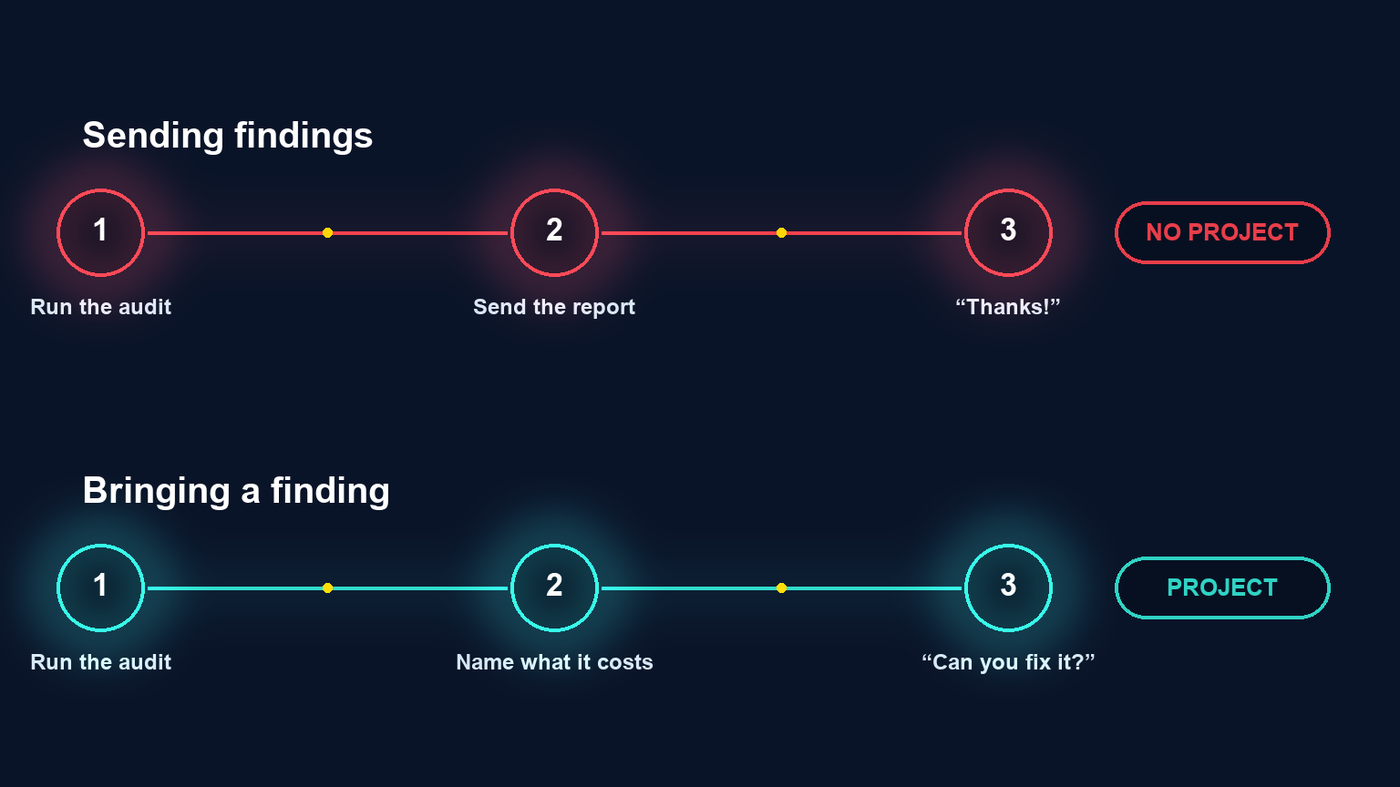
The difference between those two positions? One gets a “thanks for the info.” The other gets a project.
And here's what I've seen over twenty years: the person who can do this consistently doesn't just win one project. They win ongoing work. Because once you've proven you can find what matters and explain why it matters, clients want you to keep doing that.
Who This Approach Works For
You don't need any special tools to do this.
No particular tech stack. No prior experience running audits. No expensive certifications.
If you own an agency, work as a consultant, or freelance in any kind of digital marketing capacity, this approach is built for you.
The skill you're developing is client acquisition through demonstrated expertise. Show them you understand their problems before you ask for the contract. That's it.
Frequently Asked Questions
Can I really find something meaningful without backend access?
Yes. Most problems that cost businesses money are visible from the outside. You're not doing a comprehensive technical audit, you're finding the specific issue that opens a conversation.
What if AI tools can do this faster?
AI can generate reports. It can't sit in a meeting and explain why a specific finding matters to this business. The interpretation and positioning is still human work.
How do I avoid sounding like I'm just pitching?
Lead with the finding, not the sale. Explain what you found and what it's costing them. If you're right, the next question is usually “can you fix it?” Let them ask.
Your Next Steps
- Pick a prospect's website, someone you'd actually want to work with
- Spend 10 minutes looking for one problem you could explain in business terms
- Practice articulating why it matters (cost, missed opportunity, competitive disadvantage)
- Reach out with the finding, not a pitch
If you want a checklist to run against while you look, the Measurement Audit Toolkit covers the configuration checks that surface the most billable problems.
If you've ever looked at a prospect's site and thought something felt off, that instinct was the start of a project. This is how you finish the thought.